Tuesday, August 3, 2010

Editor's Corner


Aug 2010

"Procrastination: I like to think of it as Divine Intervention." --Mary E. Adair


August brings in the real heat of the summer in our area ordinarily but this summer it happened in July. Well, your editor hopes the worst of it is over. The important news seems to drench us daily as Television and Radio duplicate it 24/7. That is why it is nice to browse the ezine which is filled with unusual travel and vista's, reflective notions, unique recipes, historical references, sporting observations, and romantic viewpoints.

LC Van Savage leads the articles with "Men and Gas Tanks and Other Fables." Leo C. Helmer informs us concerning another Western Swing personality, Hank Penny. Of course LC Van Savage also has her column "Consider This" bravely discussing tennis attire and stars, and Helmer's column "Cookin' With Leo" serves a tasty summer treat, "Aztec Coffee." Another kind of summertime activity is discussed in Peg Jone's "Angel Whispers."

Our columnists bring their own brand of reporting such as humorist Gerard Meister offering insight on airport security first hand. John I. Blair in "Always Looking" shares some history and priceless photos detailing family choices of where to attend religious services. Thomas F. O'Neill fills us in about his experiences at the Shanghai World Expo and Mattie Lennon sends news of the Knockanstockan Musical Festival in Ireland and includes a tale and a poem from the CIE literati.

With a baker's dozen of poems - one from MJMansfield plus six each from Bruce Clifford and John I. Blair, the reader will find an assortment of poetic information and styling.  Also, Mark Crocker adds a second installment in the Stories section of his "Rabbo Tales."

Don't forget to mention us to your friends, be a fan for us at FaceBook, and limber up those writing muscles for a future issue.
See you in September!


Click on Mary E. Adair for bio and list of other works
published by Pencil Stubs Online.

~Rhymes for Rhymes Sake~

I used to dream of words in rows
Like flowers waiting for the sun to grow
I spoke in rhythms rhymes and prose
Hidden agendas with joy I’d show

Words flowed thru me night and day
A sick curse or game that I had to play
I could not think of things shallow or gay
Every minute a new theory to say

Emotional gritty and real
Constant thought with which to deal
My bloody stamp the poets seal
A crazy captain at the wheel

Where is that boy's wandering mind?
Is this the end of his watches wind?
Or is he waiting for more of his kind?
Could he just be biding time?

©8-2-10 MJMansfield


Click on M. Jay Mansfield   for bio and list of other works 
published by Pencil Stubs Online.

Sunday, August 1, 2010

Always Looking


Always Looking: 

Religion On The Frontier


Many motives brought people to the New World from Europe. Lust for land; greed for gold and silver and gemstones and furs; hunger for new fisheries after all the herring were fished out of the North Sea; zeal for new converts to Christianity. But one of the motives we love to hear about was the yearning for a land where one could follow one’s own faith without persecution, a yearning that famously brought the Pilgrims to New England, the Quakers and Huguenots and Moravians to Pennsylvania, Catholics to Maryland, Mormons to Utah, Mennonites to Kansas.

Much of early American history includes religion as part of the tale. Often one of the first buildings to be built in a frontier community was a church, sometimes – where population was light and beliefs diverse – a nondenominational church. While churches in American settlements were rarely the center of the community (that typically was the schoolhouse, at least in the Midwest), they were very important. And knowing something about the varieties of faith on the frontier can help explain migration patterns, community organization, and sometimes even how the land was settled up and divided.

In my own family, though much of the information has been lost, it’s known that some on both my mother’s and father’s sides came here from England to join the William Penn community of Quakers in Pennsylvania. The Boones came from Devon to the Oley Valley near Reading; the Reeves family from Essex via Burlington County, New Jersey, to the Chester County area west of Philadelphia.

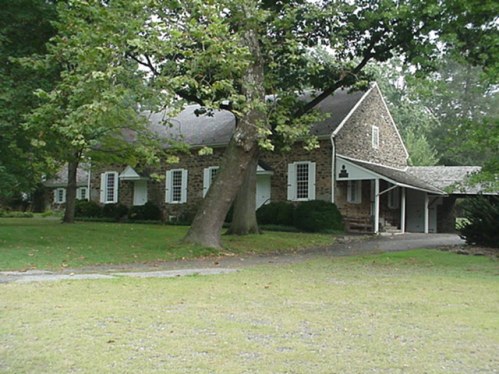
London Grove Monthly Meeting (Quaker) shown above.

While my kin eventually left the Quaker Church (or were “disowned” for improper behavior such as marrying non- Quakers), family tradition has it that our Quaker heritage shaped some of our personality, which trends toward the mild and peacemaking (in most, though not all, members of the family). And many of my family branches dispersed west across the new land along the general path followed by Quaker settlement – Pennsylvania, Ohio, Indiana, Illinois, Iowa.
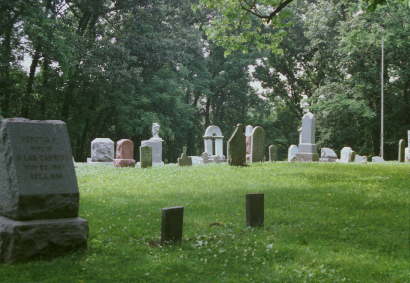
Then there were the Piggott, Patterson, and Rogers families: settlers in Missouri before it was part of the United States. (It was Spanish, then, briefly, French.) They brought with them their new Methodist and Baptist faiths and helped found the oldest Protestant cemetery west of the Mississippi still in use, the Cold Water Cemetery
Cold Water Cemetery near Florissant Missouri

near present-day Florissant, Missouri, which was originally associated with a small Methodist church erected in 1808 that was later converted into a Baptist church. Numerous of my people are interred there. My maternal grandmother was born near there. In fact, my mother’s family to this day are almost all Methodists, with an occasional dalliance with the Baptists.


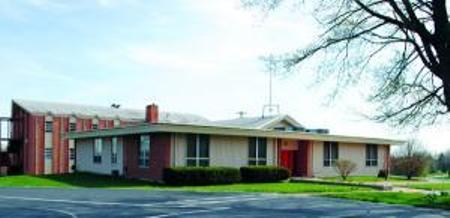
Salem Baptist Church Florissant Missouri shown above

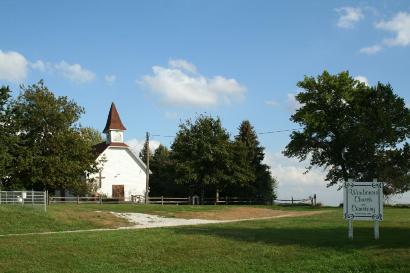
In Iowa, the Blairs and Linvilles of my father’s family helped found the first church of any denomination in Mills County (east of Omaha) in 1853. The Wahbonsie Church (Disciples of Christ) is still standing, in a later construction, though now used only occasionally.
Wahbonsie Church, Mills County, Iowa

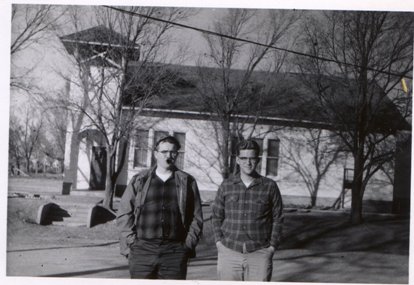
Great-great Grandpa Thompson Milton Blair and his wife Sarah Linville Blair both signed the original Articles of Organization. Many in their rural frontier community were members. And my great-great-great grandfather Zachariah Linville, Sarah’s father, died while trying to bring religion to the gold miners of early California, where he is buried on a hillside near the former Hangtown (now Placerville). Part of family lore, and true. My paternal aunts and uncles in western Oklahoma mostly centered their Sundays, marriages and burials, around the Christian Church (Disciples of Christ) near the center of Camargo, which is located on a terrace of arable land above the South Canadian River. It’s the only church I can remember ever noticing in Camargo (though I understand there are a couple of others).
Charlie and John Blair in the 1950s in front of the Camargo, Oklahoma, Christian Church
My wife’s family, German Catholics, settled in the late 19th century in a Catholic neighborhood in Brooklyn that to this day has a parish church in almost every other block (though several have closed as demographics changed in the last 50 years). The Franz and Rohner families were almost forced by their religion to stay in New York after immigrating, or at least to settle in a large urban area, because that’s where they could find a Catholic community in this country that was largely settled by Protestants, at least up to that point in our history.
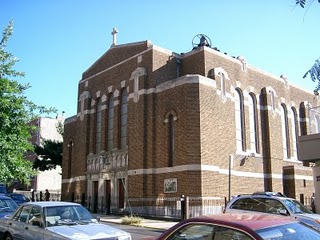
Holy Family parish church Brooklyn, New York
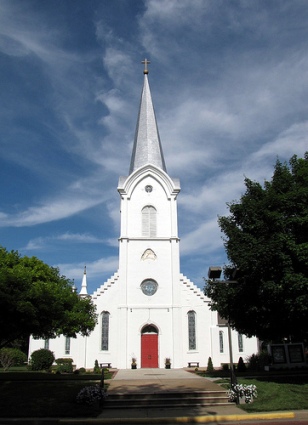
And the landscape of some parts of the country reflects this immigration of religious communities. Where I grew up, in central Kansas, the countryside is dotted for miles by scores of ethnic churches. In one area, west of Wichita, all of them are Catholic, parishes founded by settlers from the German Rhineland Palatinate. St. Marks, St. Mary’s, St. Joe, and others now subsumed in larger towns. Another, larger area to the north of there is dominated by Mennonite churches founded by groups forced out of the Volga area of Russia when their exemption from military duty was revoked around 1870. Alexanderwohl, Goessel, Hesston, New Gottland, Waldeck. And farther north of there, the rich valley of the Smoky Hill River was settled by Swedish Lutherans, in towns such as Smolan and Falun and Lindsborg. To this day Lindsborg hosts a Svensk Hyllningsfest every October, centered on the Lutheran college and church in the center of town and featuring lots of Smörgåsbord.
Bethany Swedish Lutheran Church Lindsborg, Kansas
The character of several thousand square miles of Kansas prairie settlements was established by these religious groups. Even the landscape was affected, as several groups brought with them a Central European practice of tilling farmland in long, narrow strips where crops were rotated. And the Mennonites are credited with introducing winter wheat to Kansas, where to this day it remains the most important grain crop.
Students of genealogy know that church records can be one of the most valuable resources for documenting births, baptisms, marriages, and deaths. Especially the Mormons, Quakers, Catholics and Anglican/ Episcopalian churches keep careful records and often will share them with outsiders, if asked politely. I got much aid in tracing some of my Quaker roots from a friendly researcher at Earlham College (Quaker) in Indiana. Thousands of family history buffs seek assistance from Mormon records. And the parish registers of England, Scotland, Wales, and Ireland (and other countries, wherever the records have survived centuries of wars and civil disruption) are essential documents for anyone tracing their earliest antecedents.

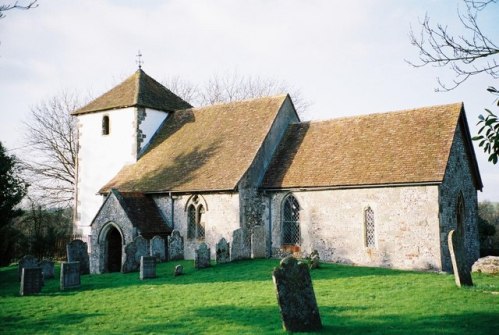
Church of St. Mary Winterbourne Gunner Wiltshire shown above.

Religion is still a major part of our lives for most; and in the past it was often, literally, the center of life, the hub of history. Knowing about your family’s religious traditions can be a valuable guide to understanding who you are, and where you came from. Pretty obvious, yes; but worth repeating.
©2010 John I. Blair


Click on John I. Blair for bio and list of other works published by Pencil Stubs Online.

Cookin' With Leo


Aztec Coffee


A long HOT, and DAMN HOT, summer here in West Texas, so cooling out on the back Patio is how I have been spending this summer. Well, one particularly Damn Hot day I was cooling off with a cold tall one, whatever, when who should appear out of nowhere, but Aztec Annie. Am I seeing things or really dreaming, I wondered? What is Aztec Annie doing around here all by herself?
“Hey Annie”, I said, “what are you doing around here all by yourself”? “And, where is my Dear Sweet Italian Fairy Godmother”? “Don’t you two pal around together anymore”?
“Yea, well, she on vacation somewhere in the South Pole”.
“South Pole”, I stammered, “What in hell is she doing in the South Pole”?
“She say it’s too --- hot (fairies never use slang (cuss) words) where she was.”
“Geez, never heard her say that before, she spends most of her time in Rome anyway, fluttering around in the ruins of Caesar’s Villa, wherever, digging up old copies of Caesar’s Concubine’s, Kitchen Classics, whatever.”
“She say, Rome too hot this year too, so she take off for South Pole, where she say it Cool Place.”
“I guess so Annie, might be a good place for West Texans too, this summer.”
“Hey, well, I no come to shoot breeze too long, I want out of this Hades (see no cuss words)Hole too, so sit tight, I got nice cool Aztec Coffee recipe for you and all your Texas friends or anybody else to cool off.”
Annie don’t use a magic wand thing like My Dear Sweet Italian Fairy Godmother does she just goes “TATATATATATATATATATATATATATAATATAT…..” and magic happens, whatever.

Anyway, so now I have a nice coffee cooler for the long hot summer and a waker upper too, whichever, so here it is and I am calling it Aztec Coffee. Got a better name?

For Annie’s Aztec Coffee, here is what you need:
    3/4 cup dark roast coffee, fine ground
    1 teaspoon cinnamon plus extra for dusting
    1 cup Half and Half coffee cream
    1/3 cup unsweetened Cocoa powder
    ¼ cup packed brown sugar
    1 teaspoon pure Vanilla extract
    6 tablespoons pure whipped cream
    6 cinnamon sticks, long to use in cups
And here is how we do it:
Place the coffee and the 1 teaspoon cinnamon in your coffee maker, add six cups water and brew according to your coffeemaker’s directions. Meanwhile place the Half and Half, Cocoa powder, and brown sugar in a saucepan and simmer on low heat till sugar is dissolved. Don’t scorch or burn. When the coffee is finished brewing, pour it into the Half and Half mixture. Divide the mixture between six coffee mugs. Top each with a spoon of whipped cream and dust with Cinnamon, Serve hot with a cinnamon stick for a stirrer.


Annie did not tell me this but you could add a shot of rum or tequila to each cup.


Click on Leocthasme for bio and list of other works published by Pencil Stubs Online.

Introspective


My Experience at the Shanghai World Expo


During the month of July I lived and worked as a teacher at a summer camp in Shanghai, China and while I was there I visited the World Expo. I went to the Expo with a fellow teacher, she is from England, and we quickly noticed the frenzy among the Chinese visitors. Chinese people were carrying passports and they were having them stamped at each pavilion they visited. My friend Stephanie explained to me that the Passports were not real they were just Expo souvenirs.

The frustrating thing about the Expo was the majority of the Chinese with these fake passports could care less what was in the various pavilions. They waited in ridiculously long lines for hours to have their passport stamped by the pavilion staff. Some of the Chinese would bring other passports with them to have them stamped for friends and relatives. This intrigued me because of the value that was being placed on these fake passports and the pavilions stamps rather than the marvelous exhibits inside the various pavilions.

The fake passports cost about 30-Yuan (U.S. $4.40) and they have taken the Shanghai Expo by storm. My friend Stephanie and I were a bit disappointed by the ridiculously long lines. People were waiting 4 to 5 hours just for the stamp at the various Pavilions we were hoping to visit.

Over 80,000 booklets (fake passports) are sold each day at the World Expo by the DOW group. They are expecting to sell over 70 million booklets by October 31st the date the Expo is due to end. The booklets look like real passports and the stamps at the pavilions look like entry visa stamps. Souvenir shops are providing the passport photos for the booklets for an additional 20-Yuan (U.S. $2.94).

Most of the Chinese buying these booklets never left China and this is a way for them to feel as if they actually traveled the world. They want to hold on to the booklet as a souvenir. Over 80 percent of the Chinese visitors have bought the fake passport booklets and its popularity has set sales and profits through the roof.

When the Expo first opened the Souvenir shops throughout the Expo grounds were running out of booklets in less than an hour. They still are running out of booklets due to their popularity. The Souvenir shops place signs in their window “No Passports” each time they run out. The “passport available” signs draw huge crowds to the shops.

A shop assistant yelled in Chinese “we have Expo Passports” causing a stamped of people rushing to the shop.

People are also placing Ads in Newspapers looking to hire very old people or people who are physically handicapped. People want to hire them for the day so that they could use them to bypass the long lines at the Expo. The staff at the various pavilions allow the very old and the handicapped to bypass the long lines. Some of the ads say the elderly or the handicapped person will be picked up at their home and dropped off at the end of the day. They will be paid 100RMB (U.S. $14.70) including two meals for the entire day at the Expo.

When I went to the Expo I wanted to visit as many pavilions as possible but the long lines was a bit frustrating to say the list. When I learned about the fake passport holders and the frenzy for the pavilions entry visa stamps I started to laugh. My friend Stephanie however reminded me that the Chinese buying those booklets never had the privilege to travel outside of China and they never will. Getting on an airplane and traveling to various countries is something that I as an American take for granted.
At the summer camp my students were all from various countries, South Korea, Taiwan, Singapore, Thailand, and Malaysia. I also had a student from New Zealand who asked me what I saw at the Shanghai Expo.

I told him in a somewhat humorous way, “many, many, many, many, Chinese people waiting in long, long, lines.”

The students quickly corrected me because they visited the Expo too. I was quickly reminded that they are not Chinese and they waited in those long lines as well.

Working at the summer camp for the month of July was a great experience. I truly had a great time working with the kids from various countries. They reminded me of the things I enjoyed doing as a child and they certainly brought the child out in me. That is certainly a good thing for this coal cracker from the Pennsylvania coal region and I hope I have the privilege of working there next summer as well.
Always with love from Suzhou, China
Thomas F O’Neill, Shenandoah Native

Phone: (800) 272-6464
China Cell: 86-15114565945
(800) 272-6464
China Cell: 8615114565945
Skype: thomas_f_oneill
Other articles, short stories, and commentaries by Thomas F. O'Neill can be found at the links below.

Click on Thomas F. O'Neill for bio and list of other works
published by Pencil Stubs Online.