 Always Looking – The Story of Liberal, Missouri
Not so long ago I wrote a column about the role of religion in
the settlement of America, about its central place in much of our
history and society. Most American towns have had churches at, or near,
their centers.
But not every town.
Liberal, Missouri, is a quiet – almost somnolent – small town in
western Barton County. Quiet people – many of them retired – quiet
streets. You’d never in a million years think of this as a hotbed of
radicalism. Unless you notice there is a street named after Charles
Darwin, author of the Theory of Evolution; another named for Robert G.
Ingersoll, 19-century freethinker, humanist, and brilliant orator; and a
third evidently named for Peter Payne, 15th-century Lollard heretic
(follower of John Wyclif), later a Taborite (part of the Hussite
movement in Bohemia).
In fact, at its inception, Liberal was an extraordinary social
experiment, unique (so far as I know) in America. Instead of being
founded as a city of churches, it was founded, deliberately, to be a
city
without churches – a Utopian city of Freethinkers.
George H. Walser (after whom another Liberal street is named) was
a poetry-writing attorney from Indiana. Following Civil War service, he
moved to Barton County and set up what soon became a very successful
law practice. Having already been a member of a local Freethinkers group
in the county seat, Lamar, but finding his beliefs too unpopular there,
in 1880 he bought 2,000 acres of prime farmland 17 miles northwest of
Lamar and planned an experiment in intellectual community living, along
the lines of the New Harmony, Indiana, community of a generation
earlier. He wanted a place where atheists could come and live in a
churchless – and saloonless – town where people could raise their
children without religion, a place where freethinkers could live to
their standards of decency and morality in a quiet, unmolested way, away
from missionaries and the barrage of religion. Christians were not to
be allowed. Liberal was advertised as “the only town of its size in the
United States without a priest, preacher, church, saloon, God, Jesus,
hell or devil.”
|
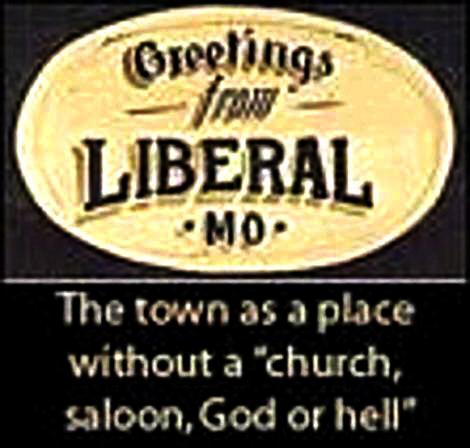 |
| Liberal Sign |
|
“With one foot upon the neck of priestcraft and the other upon
the rock of truth,” he declared, “we have thrown our banner to the
breeze and challenge the world to produce a better cause for the
devotion of man than that of a grand, noble and perfect humanity.”
In harmony with the purpose for organizing the town, a number of
unusual institutions, designed to promote the ideal community, were
tried in Liberal during the 1880s and 1890s. The first of these was a
Sunday Morning Instruction School, where children were taught from
“Youth Liberal Guide” and from various works on physics, chemistry, and
other sciences. In another class organized for older young people,
elementary experiments in the physical sciences were performed under the
supervision of teachers whose avowed function was to encourage and
direct free, intelligent discussions. An orphanage was begun where Free
Thought was the rule. In a structure called the Universal Mental Liberty
Hall, lectures were given each Sunday evening, and scientists,
philosophers, socialists, atheists, Protestant ministers and Catholic
priests were invited to speak – respectable decorum being the only
limitation placed upon any speaker. Large, enthusiastic crowds gathered
there each week in the interest of mental liberty. The Liberal Normal
School and Business Institute was another institution organized by
Walser to promote liberal education free from the bias of Christian
theology. This school was well-advertised and soon had a large
enrollment. According to a tract published in 1885, the Liberal Normal
School and Business Institute was “located in the liberal town, taught
by liberal teachers and courted only the patronage of liberal patrons.”
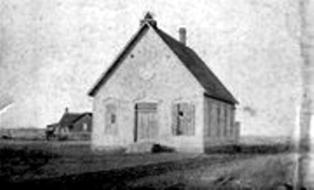
Out of this organization developed Free Thought University, which
opened in 1886 with a staff of seven teachers and a course of study
“untrammeled by Bible, creed, or isms.”
|
Free Thought University |
There were actually people at the train station warning Christians that they were not welcome. So naturally some Christians barraged the town on missions to convert the heathens.
|
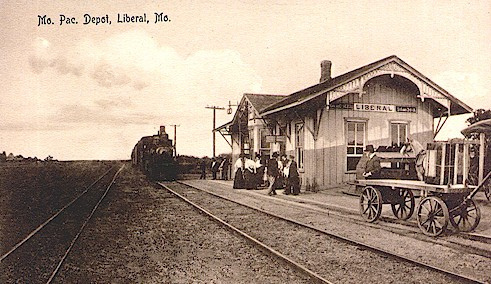 |
| Shown above: MoPac depot Liberal, Missouri |
|
Shortly after the city was founded, a Christian by the name of H.
H. Waggoner bought a parcel of land to be an “addition” to Liberal for
the express purpose of “living unmolested and watching with contempt the
doings of their infidel neighbors” and “inducing immigration of
Christians who would be strong enough to outnumber the Liberals and
defeat the enterprise.” The new, Christian, community was named Pedro.
The good (albeit non-Christian) citizens of Liberal (reportedly
including even the women) responded by building a big barbed-wire fence
to isolate the Christian missionaries.
In spite of the fence, and the warnings, more Christians came,
bought homes, and quietly began holding religious services, although
Walser more than once managed to put a stop to the services by proving
he still had part ownership of property where they were being held,
hence the right to control activity there. The services were moved to
Pedro. (There still is a street in west Liberal named Pedro.)
People throughout the county, the state, and even other parts of
the country, took interest and took sides – mostly the side of the
Christians. Unfavorable, and perhaps libelous, articles, pamphlets, and
books were written and published. Accusations of rampant drunkenness,
divorce, loose morals, and even open practice of birth control, were
made. For example, “In no town is slander more prevalent, or the charges
more vile. If one were to accept what the inhabitants say of each
other, he would conclude that there is a hell, including all Liberal,
and that its inhabitants are the devils.” [St. Louis
Post-Dispatch 1885, in an Op-Ed piece quoting an anti-Liberal pamphlet]
Inevitably, with all the controversy, passionate opposition, and
bad publicity, the town’s real estate values and commercial activity
suffered and many of the settlers lost their investment. Ultimately both
churches and saloons did move in. The Universal Mental Liberty Hall was
sold to the Methodists. Walser was converted, first to Spiritualism,
eventually, before his death in 1910, to Christianity. The experiment
had failed. Only the street names, a few recycled buildings, and some
unusual memories were left. Oh, and the cemetery specially designed by
Walser in which all the markers are arranged in concentric rings around a
central circular space where Walser himself was to have been buried,
supposedly to be the first thing resurrected people would see when they
arose from the grave. (He was actually buried in Lamar.) Nowadays there
are seven churches in Liberal, one for every 100 citizens.
And why do I take interest in this obscure, somewhat bizarre, bit
of American history? Liberal, Missouri, is the town where, when I was a
boy growing up in the 1940s and 1950s, once or twice a year I traveled
with my family to visit my one and only living grandparent, Grandpa
Percy. If I gave any thought at all to the character of his hometown, it
was to judge it as a conservative backwater where the town generator
was turned off at 10:00 p.m. (and we went to bed by kerosene lamps),
sidewalks were rumpled expanses of locally molded and fired red bricks
stamped “Liberal” (I have a few of these in my garden walk here in
Texas), half the shops on the two-block main street were closed and the
others looked ready to close, and the closest approach to higher
education was the old public school building down the street from
Grandpa’s house where to me the main attraction was a big steel
merry-go-round and an unusually high, hump-backed, slide on the
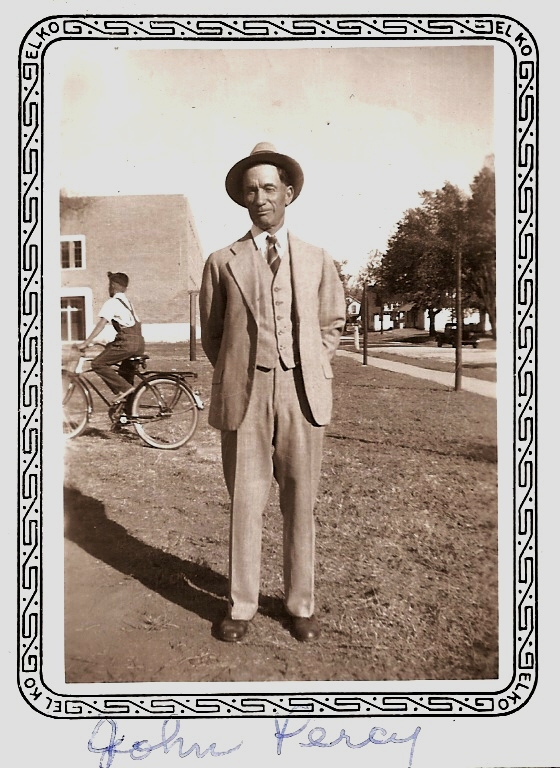
playground. (See pic of Grandpa Ernest John Percy on the school grounds
at bottom of Page.)
The moral to this story is (at least) threefold: (1) the story of
America is richly textured, (2) even the sleepiest little backwater can
hide a history you would never guess at, and (3) don’t try to start a
radical social experiment in the heart of the Bible Belt and expect it
to thrive.
© 2010 John I. Blair [with materials drawn from an article at Ziztur.com, the article on Liberal in
Wikipedia,
and personal observation; there is a surprising amount of information
on the Internet about Liberal for an obscure country town of 700
population]
Click on
John I. Blair
for bio and list of other works published by
Pencil Stubs Online.


 Posts
Posts