William Henry Joslin,
a Look
At His Life and Times
Growing up, I was regaled with tales of family, tidbits
that seemed to enrich my understanding of how important family is to all
its members. My mother was raised in a home filled with boys – her
brothers, her cousins who had lost their parents and come to live with
their Joslin grandparents, her uncle, father, and their friends and
neighbors. By contrast, my father was an only child, tossed about in his
early years until his maternal grandmother and her husband brought him
to their farm and provided nurture, comfort, love, security and his own
sense of the value of family. DaddyJack learned to love my mother’s
parents deeply and enjoyed the camaraderie the full house provided. He
made us smile as he, fondly, recounted his first venture to MomMay’s
farm with the intent of courting her. We were watching Hee Haw, a
favored comedy show at the time and DaddyJack started laughing. His
laugh was a thing of wonder – a deep, rumbling, rich belly laugh that
made everyone around him want to join in his glee. He said, “You know,
those Joslin boys were all BIG men. Each about 6 foot or more, and none
were lacking for girth. They all had a hound dog and everyone of them
carried their own long rifle. Can you imagine my quaking knees as I
ventured forth, intent upon my goal of a proper courting of a very
proper beautiful young lady. As I trod the dirt path to the farm, from
every field, every tree, behind every rock, I saw Joslin Boys, eying me
warily. Believe me, it was true love that kept me on that path!”
Genealogical Profile:
William Henry Joslin was born 11 April 1837 in Kane
County, Illinois. The Joslin land patents indicate all lived in
Burlington. His parents were William Riley Joslin and wife, Eunice
Evans. My grandfather, James Arthur Joslin, always recounted his father
was “William Henry Joslin, son of William, son of William.” The third,
eldest, of that trio is our elusive and charming William “P. R.” Joslyn,
whose initials (by which he was frequently called) have evaded
decoding. Could it have been Papa Riley since the son was Riley? Perhaps
Preacher Riley? Could it indicate another given name? Many parents
bequeath their children with multiple given names. Could it be … William
Paul Riley Joslyn? WHAT?
The entry of the Joslyn family to Burlington, Kane
County, Illinois, sparked quite a bit of intrigue – so much so it has
been recorded in more than one History of Kane County Illinois. First a
bit of history:
According to "History of Kane County (IL) by R. Waite
Joslyn & Frank W. Joslyn, 1908", P. R. Joselyn (sp) arrived in 1836,
among the first people to occupy what would become the township of
Burlington, Kane County, IL. He was followed in the year 1837 by his
son Riley. A narrative text of the history of that county contains the
following:
*1835: Stephen Van Velzer
claimed nearly the whole township. Settlers who followed were forced to
buy land from him or face controversy.
“P. R. Joslyn, a kind of
migratory character, but a good man withal, settled in the town in the
early part of 1836. He was originally from New Jersey, but had lived in
Ohio, Kentucky and Indiana. From the latter state he came to Burlington.
He had some difficulty with Van Velzer, in regard to his claim, who
attempted to collect a sum of money from him as a bonus for the
privilege of settling on it. Upon inquiry, he learned that Van Velzer
had no just grounds for such demands, and so he settled upon the claim
selected, in open defiance of him. His son, Riley Joslyn, came the next
season, and took up a claim in the township.” SOURCE: History of Kane
County Illinois: The Past and Present of Kane County, Illinois, 1878.
The Joslin clan immersed themselves in local politics
in each of the areas to which they migrated. They bought goods in
auctions which also left a paper trail. There were also some intriguing
little mysteries, such as the one your author found years ago regarding
the Brick Wall master, P. R. Joslyn. It is known William Henry named his
first-born son, Marion Alonzo. In one of my searches I found a listing
for “the estate of P R Joslyn”. Immediately, located a genealogical
inquiry site for that area and posted the following:
SOURCE: Name: Melinda Carroll (Joslin, maternal side) Cohenour Date:2001-09-09Herk/Mont
Surnames Joslyn, Joslin, Clapsaddle Herk/Mont Towns Frankfort Special
Topic Interests Genealogical Data Comments:
“My g-g-g-grandfather, P. R. Joslyn had an estate in Frankfort,
Herkimer County, NY, that was mentioned in a Directory for that town in
1869 / 1870. In that timeframe, an Alonzo Joslyn was noted as the
"farmer and overseer of the late P. R. Joslyn's estate." We have not
been able to establish the familial relationship between P. R. and
Alonzo.
P. R. Joslyn
moved out of Frankfort at a date unknown and arrived in Kane County,
Illinois in 1836, as noted in the "History of Kane County" published in
1908 by R. Waite Joslyn & Frank W. Joslyn. He was one of the early
settlers in Kane County, Illinois, and one of the first of those
settlers to die, in 1846 or '47 after occupying his homestead for a
decade. He was followed to Kane County, IL, in 1837 by his son, Riley
(James Riley Joslin). No record of Riley being in Frankfort, however,
has been uncovered.
Our research into Alonzo Joslyn's
family indicates a Gertrude Clapsaddle (Cattrout Klepsattle) married
Andrew Joselyn in 1815. This Gertrude M. is shown to be in the household
of Alonzo Joslin at a later date. We believe her to have been Alonzo's
mother, Andrew Joselyn, his father. A record of this marriage made by
the Reformed Church, Herkimer, 1815 - 1816, shows Andrew to be a son of
Silvester (of German Flats) and Gertrude to be a daughter of Andreas
Clepsattle. This record also lists Wilvester (sic) Joslin and Bolly
Shoemaker, as witnesses. In the record for this church made in
1819-1820, Sylvester Joslin (son of the late Sylvester of German Flats)
is shown to have married Elisabeth Steel, daughter of Nicholas. This
marriage was witnessed by Rudolph J. Shoemaker and Thomas B. Gillespie.
We then have Silvester's son, Hiram, marrying Elisabeth Helmer, daughter
of Henry F. No witnesses are listed. If you have information, please
correspond with me.
P. R. 's son, James Riley Joslin who
(note the spelling change) married Eunice Evans and fathered William
Henry Joslin (married 3 times, last to Malinda Ellen Bullard) and
fathered James Arthur Joslin, my mother's father. Family lore indicates
this branch was in NJ, NY, IL (Kane County, where PR died in 1846 /
1847), IND, OH, (Shelbyville), PA, and MO.
Any information you may have would be appreciated.”
Could this be a relative, as yet unidentified, and the
person for whom Marion Alonzo was named? Further research, obviously, is
needed.
The Joslin clan remained in Kane County, Illinois until
the year following William P. R.’s death when a general group migration
brought them into Missouri. We know of the year of P R’s death again by
virtue of the excellent historical records maintained by R. Waite and
Frank W. Joslyn:
“THE FIRST DEATH: Each
moment in dying bears with it a dead human being, flowers perish and
spring again, suns set at eave and rise again in the East, but the dead
render not up their dead to mortal eyes. Death, the grand leveller of
human greatness and human ambition, entered the infant settlement at an
early period of its existence. Van Velzer's wife was the first victim
of the grim tyrant. She died in 1837 and was buried amid the
wildflowers of her prairie home. A native of the sunny South, her
tender frame was unable to withstand the fierce winds of a colder clime.
Others of the early settlers in time followed her to the better land.
Joslyn, perhaps, was one of the first, and died about 1846-7. Stephen
Godfrey died on his original claim in 1857, and Holden in 1875.
VanVelzer sold out and moved into DeKalb County, where he died about the
year 1867.”
We can place the approximate year of their move to
Missouri by the Census records which indicate year and PLACE of birth
for household members. William Henry’s sister, Sarah A. was born in
Illinois in 1844. His brother, Harvey E. was born in 1847 in Missouri.
This agrees with the family choosing to make their move following the
death of their father in the timeframe 1846-1847.
The US Federal Census enumerated 7 Nov 1850 for
District 64, Nodaway, Missouri, lists the following household: Riley
Joslin 55, Eunice Joslin 45, Johnathan C Joslin 15, William H Joslin
13,
Leonard M Joslin 9, Sarah A Joslin 5, and Harvey E Joslin 3. Our William
Henry is a strapping young man of 13. Shortly before this Census, we
learn of a momentous event in his life. (NOTE: the handwritten note
below indicates his age to have been 18 when this trip was made;
however, records show the trip had to have been undertaken in early 1850
for the death information in May of 1850 for Rhoda Orvis Joslin
research discovered to validate the tale.)
When William Henry was
eighteen years old and living in North Missouri, he started to
California in the Gold Rush with his uncle and family. They all got sick
out on the Plains with cholera and turned back to Missouri. The entire
family died, except for William Henry and a small girl, Mary, four
years old. Later, she became Mary Schooley. He returned the
four-year-old girl to another uncle in Nodaway County, Josiah Joslin,
who took her and cared for her. She lived with another uncle (Josiah
Joslin) until she was older. Grandpa wouldn't talk about this very
much. SOURCE: Family History Notebook maintained by Carrie Bullard
Joslin; this entry dated 1946.
Research into this event may lead to an understanding
of the apparent (not proven nor spoken of) alienation of the family of
Josiah Joslin, uncle to William Henry and a brother to Riley Joslin. No
records of letters, family get-togethers, or other events show Riley and
Josiah to have been close. They lived not that distant albeit travel
was not undertaken lightly in those days. It has been suggested they
were half-brothers, Riley and Josiah, born to two different wives of P.
R. and young Jonathan (the ill-fated uncle to William Henry whose wife,
and other family members contracted cholera on that trip to find their
fortunes) was a full brother to Josiah. (This has not been confirmed.)
Taken from more of my notes and compiled research is the following:
Jonathan Joslin was born circa 1818 in OH and died
1851 in Andrew Co., MO. Jonathan married Rhoda Orvis July 3, 1845 Kane
Co., IL. Rhoda died in May of 1850 Andrew Co., MO. [One of the more
tragic tales in our lines' history. Jonathan, his young wife Rhoda, her
younger brother, our great-grandfather, William Henry, and others joined
a wagon train headed to California during the Gold Rush. The wagon
train chanced upon tainted water, it is believed, for most contracted
cholera on the Plains. Whatever the disease, Rhoda succumbed early, and
Jonathan died after a lingering illness. Their little daughter, Mary
Elvira Rhody Eliza (think I have the order of the names correct) Joslin
-- later known as Mary Schooley, and our great-grandfather, William
Henry, are believed to have been the only ones who survived. Family
history notes that William Henry brought the little girl to his Uncle
Josiah who, with his wife, Peggy Carnahan Joslin, raised the child as
their own. Rhoda Orvis Joslin's death is listed in the Mortality
Schedules for that county in 1850. Jonathan died in 1851, I believe.]
From Wikipedia, we find the following:
During the California Gold Rush, cholera was transmitted along the
California, Mormon and Oregon Trails as 6,000 to 12,000 are believed to
have died on their way to Utah and Oregon in the cholera years of
1849–1855. SOURCE: Rosenberg, Charles E. (1987). The Cholera Years: The
United States in 1832, 1849, and 1866. University of Chicago Press.
ISBN 978-0-226-72677-9.
At any rate, this works to provide us with an intimate
look at the life our ancestors led. The hopes and dreams and the
heartbreaks they suffered along the way.
Before his marriage, William Henry chose to enlist in
the Union army. He served a full three years with the 33rd Regiment of
Missouri Infantry. Again, we have both notes from our grandmother,
Carrie, the early family historian as well as confirming public records
to confirm his service. (Please see below for the separate documentation
for his Regiment’s participation in the War.)
William Henry joined the
Northern Army in the Civil War from Nodaway County, Missouri, and served
the entire four years under General A. J. Smith. When the War closed,
he returned to North Missouri for a short time and then came to Jasper
County, Missouri, where he met and married Sarah Jane Godwin in Carthage
in 1866. They lived in Jasper and Lawrence Counties for about eight
years and then moved to McDonald County. They both lived near Pineville
until their death. [These notes were taken from the family notebook of
Carrie Joslin in 1946.]
Any time we discuss family historians, we cannot ignore
the tremendous contribution to our knowledge furnished by Aunt Linnie
Jane Joslin Burks. Here is one of her notes:
When the Civil War came, William H. enlisted and fought four years in
the Union Army. Some of his friends were from Joplin area, so he came
back to South Missouri to find work. One of his friends was from
Louisiana. He played a flute during the war. When they parted, he gave
his flute to his friend, William H. Joslin. I still have the flute and
have heard this story many times.
This flute, along with all of Aunt Linnie Jane’s
records, were to be handed down to your author. However, sadly, Uncle
Edgar became unable to continue to live separately and it is believed my
cousin, Alice Anne decided to donate the boxed materials to the
library. At any rate, none of the treasures ended up in my possession.
Alice Anne had devoted her life to library service, becoming the head of
the Regional Library in Jefferson City.
Additionally, among some documents handed down by
Carrie Bullard Joslin, was a handwritten note appended to an enlistment
form, together photocopied to become one document, that showed William
Henry actually enlisted TWICE, records confirming that are shown below:
Handwritten note indicates "William H. Joslin, son of
James Riley Joslin, Enlisted Twice". A second form copied onto the same
sheet reads as follows:]
"William H.
Joslin, aged 24, Rank Private, Company F, Captain Carr. Enlisted August
12, 1862, St. Joseph, Missouri. Mustered in, September 3, 1862, at B.
Brks., Mo. Mustered out: August 10, 1865 at Benton Barracks, Mo."
Unknown book, page 458 of Civil War data shows:
"William H. Joslin, Company C. Cranor's 6th Regiment, Six Months’
MSM, Company F, 33rd Infantry Volunteer. Cranor 6th, Six Months Militia
Mounted Volunteers, Private Rank, Company C, Captain Henry A. Fox,
Enlisted and was mustered in St. Joseph, Missouri, on September 19,
1861. Mustered out February 13, 1862."
"William H. Joslin, Private, of
Captain Edgar L. Allen's Company F, 33rd Regiment of Missouri Infantry
volunteered. Enrolled 12 August 1862 to serve three years or duration
of War, is discharged 10 August 1865, at Benton Barracks, Missouri,
Andrew County. William H. Joslin, born in Rains County, Illinois, is
twenty-four years of age, 5 foot 11 and one-half inches." [Army
discharge record of W.H. Joslin.]
This dedication to the preservation of the union of the
United States leads into one of our family’s favorite stories. My
mother’s paternal grandfather was William Henry Joslin. Her maternal
grandfather was William Henry Bullard. (Her favorite uncle, “Uncle
Doctor”, was William Henry Horton – but that is another story.) William
Henry Bullard served in the Confederate Army. The two would later settle
in McDonald County, Missouri, meet and marry their spouses – only to
have their children meet and decide to marry! It has oft been said,
family reunions at the Joslin-Bullard farm were like reliving the War.
Bullard, auburn haired, blue eyed, Baptist, Democrat, Confederate.
Joslin, black haired, blue eyed, Methodist, Republican, Union. Oh, my,
my, my. To have been a fly on the wall.
Great-grandfather William Henry continued to be
involved in the betterment of his community. He was called Squire
Joslin, was a Justice of the Peace (in 1909, at the age of 72, he
resigned this position), held a number of elected positions on various
boards and committees, he was elected President of the local school
board, President of the Soldiers of the Olive and Grey, and was
extremely active in every pursuit. From one of local newspaper entries,
we find a typical story:
PINEVILLE HERALD,
Pineville Mo., October 13, 1905: The first annual reunion of the
Soldiers of the Olive and Grey held at this place occurred last
Saturday. While the attendance was not great, it was fair considering
the short notices given. Several short and appropriate speeches were
made, and all present seemed to enjoy the occasion. Officers elected
for the next year for the organization of a reunion of the Olive and
Grey are W. H. Joslin, President; J. N. Taylor, Vice President; Judge J.
P. Caldwell, Secretary; and George W. Coombes, Treasurer.
From about 1905 until his death in 1921, news stories
relate several incidents where Squire Joslin had another bout with
illness. Even so, he lived to experience the early deaths of more of his
children. Both sons, Marion and Ora predeceased him. Ora passed away in
1914, Marion Alonzo in 1915. Those were hard blows.
At the end, lobar pneumonia was the great leveler,
coming on the heels of his being bedridden with inflammation of his gall
bladder. The obituary posted for Great-Grandfather William Henry
Joslin:
PINEVILLE HERALD,
Pineville Mo., April 1, 1921: Death of William Henry Joslin. William
Henry Joslin, almost 84 years of age, passed away at his home in
Pineville, at 3:30 o'clock Tuesday morning, March 29, 1921. His death
was due to inflammation of gall bladder, he being confined to his bed
less than three days. Mr. Joslin was born in Cane [Kane] County,
Illinois, April 11, 1837. At the outlet of the Civil War, he aligned
with the Union Army and served with it until the war's close. He later
came to Jasper County, Mo. where he was married in 1866 to Miss Sarah J.
Godwin. They moved to McDonald County in July 1872, and located 2
miles west of Pineville about 8 years ago. To this union were born
seven children, Marion A., Ora F., James A., Edgar L., Belle, Pearl, and
Ira L. one of whom survive, James A. Mr. Joslin has been a member of
the Baptist Church since 1881. He enjoyed the confidence and esteem of
all who had the pleasure of his acquaintance. A wife, one son, 19
grandchildren and 2 great grandchildren remain to mourn his death. The
funeral was held at the home Wednesday afternoon, conducted by Rev. M.G.
Elliff. Burial was in the Pineville Cemetery.
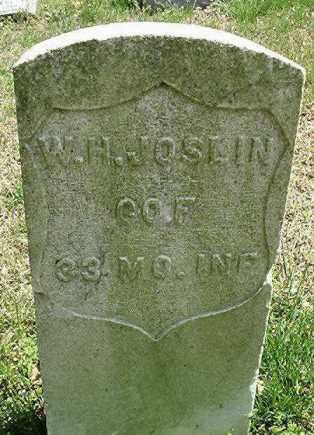
Gravestone-William Henry Joslin 1837-1921
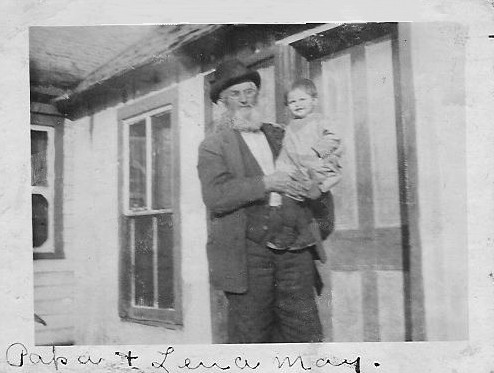
Thankfully, a photograph was taken of “Papa” with his
beloved granddaughter, Lena May Joslin. She was born in 1918, and it
appears she was about two or, maybe, even three when the picture was
taken. It is the only known photograph we have of William Henry Joslin.
Papa-William Henry Joslin-and Lenamay 17 Jun 1920
Additional Info
UNION MISSOURI VOLUNTEERS
Joslin, William H:
Side: Union
Location: Missouri
Battle Unit: 33rd Regiment, Missouri Infantry
Function: Infantry
33rd Regiment, Missouri Infantry
OVERVIEW:
Organized at Benton Barracks, Mo., August 29-September 5, 1862. Attached
to District of St. Louis, Mo., Dept. of Missouri, to December, 1862.
1st Brigade, 13th Division, 13th Army Corps, Dept. of the Tennessee, to
February, 1863. 2nd Brigade, 13th Division, 13th Army Corps, to July,
1863. 2nd Brigade, 13th Division, 16th Army Corps, to August, 1863.
Garrison, Helena, Ark., Army of Arkansas, to January, 1864. 1st Brigade,
4th Division, 16th Army Corps, Army of the Tennessee, January, 1864.
3rd Brigade, 1st Division, 16th Army Corps, to March, 1864. 3rd Brigade,
1st Division, 16th Army Corps, Dept. of the Gulf, to June, 1864, and
Dept. of the Tennessee, to December, 1864. 3rd Brigade, 1st Division
(Detachment), Army Tennessee, Dept. of the Cumberland, to February,
1865. 3rd Brigade, 1st Division, 16th Army Corps (New), Military
Division West Mississippi, to August, 1865.
SERVICE:
Ordered to the field in Missouri September 22, 1862, and operations in
Phelps, Dent, Texas and Wright Counties till December 19. Moved to St.
Louis, thence to Columbus, Ky., December 19-25, thence to Helena, Ark.,
January 5, 1863. Expedition to Duvall's Bluff, Ark., January 16-20.
Expedition to Yazoo Pass, and operations against Fort Pemberton and
Greenwood February 24-April 8. Garrison duty at Helena, Ark., till
January 28, 1864. Repulse of Holmes' attack on Helena July 4, 1863.
Ordered to Vicksburg, Miss., January 28, 1864. Meridian Campaign
February 3-March 2. Red River Campaign March 10-May 22. Fort DeRussy
March 14. Occupation of Alexandria March 16. Henderson's Hill March 21.
Battle of Pleasant Hill April 9. About Cloutiersville and Cane River
Crossing April 22-24. At Alexandria, La., April 30-May 13. Bayou La
Mouri May 7. Retreat to Morganza May 13-20. Mansura May 16. Yellow Bayou
May 18. Moved to Vicksburg, Miss., thence to Memphis, Tenn., May
22-June 10. Old River Lake June 6. Smith's Expedition to Tupelo, Miss.,
July 5-21. Near Camargo's Cross Roads, Harrisburg, July 13. Tupelo July
14-15. Old Town Creek July 15. Smith's Expedition to Oxford August 1-30.
Tallahatchie River August 7-9. Moved to Duvall's Bluff, Ark., September
3, thence to Brownsville, Ark. March in pursuit of Price through
Arkansas and Missouri to Cape Girardeau, Mo., September 17-October 9.
Garrison at Tipton and California, Mo., October 19-November 17. Moved to
St. Louis, Mo., thence to Nashville, Tenn., November 24-December 1.
Battle of Nashville, Tenn., December 15-16. Pursuit of Hood to the
Tennessee River December 17-28. At Clifton, Tenn., and Eastport, Miss.,
till February, 1865. Moved to New Orleans, La., February 6-19. Campaign
against Mobile, Ala., and its defences March 17-April 12. Siege of
Spanish Fort and Fort Blakely March 26-April 8. Assault and capture of
Fort Blakely April 9. Occupation of Mobile April 12. March to Montgomery
April 13-25, thence to Selma May 1, and duty there till July 20. Moved
to St. Louis July 20-August 3. Mustered out August 10, 1865.
Regiment lost during service 4 Officers and 52 Enlisted men killed and
mortally wounded and 2 Officers and 229 Enlisted men by disease. Total
287.
SOURCE: National Park Service website, re Civil War: Joslin, William H.
Regimental History
Thirty-third Infantry
MISSOURI
(3-YEARS)
Thirty-third Infantry.
-- Cols., Clinton B. Fisk, William A. Pyle William
H. Heath; Lieut.-Cols., W. A. Pyle, W. H. Heath, W. J.
McKee, Majs., W. H. Heath, George W. Van Beck, W. J.
McKee, A. J. Campbell.
This regiment was recruited under the patronage of
the Union Merchants' Exchange of St. Louis, and was
known as the "Merchants' regiment." It was the first
regiment mustered in under the call of 1862, and started
for the front on Sept. 22.
During the remainder of that year it was on duty at
various places within the state, but on Jan. 5, 1863, it
reported at Helena, Ark., and took part in Gen. Gorman's
White River expedition. In February it formed part of
Gen. Ross' expedition against Fort Pemberton, Miss.,
where it was for the first time under fire.
On April 8 it returned to Helena, where on May 5 it
was placed in charge of the works. It remained at Helena
until Jan. 28, 1864, when it was ordered to report to
Gen. Sherman for the Meridian expedition. Here it was
assigned to Veatch's division and remained in
Mississippi until March 10, when Gen. Mower assumed
command of the division, which was then ordered to join
Gen. Banks in the Red River campaign.
In this campaign it was in the engagements at Fort De
Russy, Henderson's Hill, Pleasant Hill, Marksville,
Bayou de Glaize, and a number of minor skirmishes. On
May 24 the 16th corps returned to Vicksburg, and in June
the regiment formed part of an expedition against Lee
and Forrest in Mississippi, having previously been in
the fight with Marmaduke at Old River Lake,
Ark.
Subsequently it was in the battles at Tupelo, after
which it was ordered to Memphis and then to St. Louis.
On Nov. 24, it left St. Louis by water for Nashville,
Tenn., where it arrived in time to assist in the
decisive defeat and the subsequent pursuit of the
Confederate forces under Gen. Hood.
It then was moved to Mobile, Ala, where it played an
important part in the reduction of Spanish Fort and Fort
Blakely, after which it was on provost guard duty at
Selma, Ala., until July 20, 1865, when it was ordered to
St. Louis for muster out, and was discharged from the
service on Aug. 10, 1865.
Source: The Union Army, vol. 4, p. 267
Battles Fought
Fought on 4 Jul 1863 at Helena, AR.
Fought on 9 Apr 1864 at Pleasant Hill, LA.
Fought on 18 May 1864.
Fought on 6 Jun 1864.
Fought on 14 Jul 1864.
Fought on 15 Nov 1864.
Fought on 15 Dec 1864 at Nashville, TN.
Fought on 16 Dec 1864 at Nashville, TN.
Fought on 22 Dec 1864.
Fought on 30 Mar 1865.
Click on author's byline for bio and list of other works published by Pencil Stubs Online.


 Posts
Posts