Thursday, July 1, 2021

Editor's Corner


By Mary E. Adair

July 2021

" “Hot July brings cooling showers,
Apricots and gillyflowers.”

– Sara Coleridge.


June now gone--welcome July. To say July is greeted with high hopes doesn't truly express the anticipation shared by so many. Here in America we will celebrate again our Independence Day on the Fourth of July. But around the world, others hail this month as the first step forward in the second half of the year--a new begining to make 2021 special in some way that will form cherished memories.


Our authors sharing experiences in their columns for this issue include Mattie Lennon (Irish Eyes) who introduces us to a new book and discusses the author. Marilyn Carnell (Sifoddling Along) recalls some creative expressions you might never have heard. Thomas O'Neill (Introspective) speaks about Quantum Physics and how the subject impacts our lives.


Rod Cohenour (Cooking with Rod) entices our palates with his version of stew -- Pork Stew Rodrigo. Melinda Cohenour (Armchair Genealogy) gives an informative tutorial on using a new tool in Ancestry's website to identify from DNA tests your personal matches on other trees. This is a step by step guideline exploring the info Ancestry offers. Mike Craner expresses his thoughts on military service and how some led to our freedom to celebrate Independence Day, in his aptly named column "Mike Craner Ramblings."


John I. Blair (View from My Back Yard) talks about the wrenching changes within his "View. . ." and adds details. Pauline Evanosky (Woo Woo) divulges conversations with former celebrities. Judith Kroll (On Trek) urges us to recognize "Collateral Damage" present in our personal actions, with an interesting explanation. She is also the author of Chapter One of the story "The Elderly Gent," with more chapters to follow in future months.


Bud Lemire's poems for July are "Roger, My Friend," "It's Okay to Be Sick," and "A New Hope." Walt Perryman, who does 'Cowboy Poetry' at Luckenbach, sent these poems "A Brand New Day," "Cyber Space," and "On My Mind." First time to have a poem by A. W. Renarcy, "Boot Prints."


John I. Blair submitted "Plum Tree" for July, and yours truly also showed one poem, "One Finds Oneself." Bruce Clifford, added these two song lyrics "Why is The Sea so Blue" and "I'm So Unsure."


Mike Craner, who keeps this eZine functioning with his ingenuity and consideration, is also a dear friend. He and wife Susie have brightened my life more than words can tell. Thanks, Mike!

We will see you in August!

Click on author's byline for bio and list of other works published by Pencil Stubs Online.
This issue appears in the ezine at www.pencilstubs.com and also in the blog www.pencilstubs.net with the capability of adding comments at the latter.

Mike Craner Ramblings


By Michael L. Craner

Yesterday, June 30th 32 years ago I was on my way to Basic Training. Still in reception center on July 4th, we were forced to stand in the rain to watch lousy fireworks.


We were given two tickets. 1 for a can of soda and 1 for a snack size bag of chips.


My first meal in the Army included half cooked rice. All I could think of was, "I signed up for 5 years of this?"


They gave me uniforms and boots, but insisted I buy my own exercise clothes and running shoes... and pay for the haircuts THEY mandated I have. That's a pretty big cut into a $632 a month wage (before taxes.)


Yet, it was the best choice of my life. I met wonderful people who I am still friends with today... went to places most will never see. Found an amazing wife and started an amazing family.


To me, all the hard times were worth it... and believe me, we've had mostly hard times since the beginning.


Don't thank me for my service. It was my duty and honor.


Don't tell me "I tried to join, but..." but you didn't and you will not co-opt the service of others because you say you wanted to serve. You couldn't, or wouldn't, and that's fine. We don't care nor do we care to hear about it. You did, or you didn't.


Despite serving in wartime, I was fortunate to not lose any close friends then... but the war took several later... some by disability, others from the ranks of "22 a Day"... still more are fighting a war that they left years ago. Myself included.


In 1776 when the Declaration of Independence was signed... our founding fathers, merchants, farmers, craftsmen, and military officers not only put their names on the line, but their lives and lives of their families for something they believed in.


That is what July 4th celebrates. Their sacrifice and courage. What they did was a rebellion or civil war. All of our patriots were nothing more than traitors to the king of England.


“The only thing necessary for the triumph of evil is that good men should do nothing.”


Happy Independence Day! It's not a BBQ, BEER FEST, firework day, or even just a day off. It's a day to remember those good men put their lives, businesses, and families on the line to make our piece of the world a better place.


With our remembrance we need to realize that this war is still going on. We must stay involved in politics and vote our hearts.


We can NEVER take a break, assuming our elected officials will actually represent us without oversight. It is OUR duty to oversee and hold them to their promises... and punish them when they fail.


Click on author's byline for bio and list of other works published by Pencil Stubs Online.

Armchair Genealogy


By Melinda Cohenour

This month there is an exciting new tool offered by Ancestry to help identify the relationship you share with your DNA matches.If you have been puzzled or confused by the array of potential relationships your DNA matches may have to you, this tool is quite helpful.


DNA analysis is quite complex. The closer your relationship to your DNA match, the greater the number of centiMorgans and both quantity and length of shared segments and the fewer possible relationships. However, the more distant the relative, the more possibilities are presented to identify your relationship to that person. For instance, my grandson was shown by Ancestry to possibly be my nephew. And once the more distant relatives appear, the longer the list of potential relationships are provided.


Be warned, in order to use this tool to its greatest advantage, your DNA test results should be linked to the most accurate and comprehensive family tree you have available and your DNA matches will have similarly linked their test results to a public tree.


Let's give this tool a try. Sign in to your Ancestry account. Click on the drop-down menu and select DNA, then select DNA matches. A screen should appear displaying the closest relative who has submitted a DNA test. In my case, it was my daughter.


Under the name, appears a question: do you know them? And beneath that will be two dialog boxes. The first replies Yes and the second suggests Learn more.


Let's assume you do recognize the first person with the closest relationship to you. Click on Yes.


In my case, the closest match was my daughter. I was offered a choice to indicate that DNA match was on Mother's side, Father's Side, or Both sides. I selected Both sides. I was then asked to identify the relationship we shared. The choices were few, and I selected daughter.


My next closest DNA match turned out to be my sister. I recognized her so chose yes. And when presented with how we were related, I selected Both sides, and for relationship chose sister. Now every time my DNA matches come up these two people will be clearly identified.


It gets much more complicated when you get to the DNA matches that are shown as second to third cousin. The choices one could make for DNA matches designated as second to third cousin, number no less than 25!


The list begins with second cousin or first cousin twice removed, or half first cousin once removed, or half grand uncle, or half grandnephew. I think you get the idea. The possible relationships run on to 25.


My first DNA match so far unidentified as to relationship, turns out to be suggested as a second or third cousin. Since I am not certain whether this cousin is related to my mother or my father and I have the same surname for both sides, I opted to Learn More.


I am given hope that I can quickly identify this DNA match because Ancestry has helpfully indicated their computer has shown this cousin and I have a common ancestor. This means someone in my tree matches to someone in the tree linked to my cousin's DNA test. Hooray!


The Learn More choice provides me with a screen with assorted pieces of information. I'm looking for the common ancestor of course, so I scroll down to the section that shows me that name. In this case there are two names, a married couple (my 2nd Great-Grandparents).


Under the name of my second great-grandfather, appears a hyperlink that says View relationship. When I click on that hyperlink, a new screen loads. If you have previously checked out Ancestry's Thru Lines, you will recognize this screen. For those of you who have not perused this tool, let me walk you through it.


The first screen that appears lists at the top the name of my second great-grandfather. Below that are the names of the people directly related that create the line of descent from that grandfather to me. Also appearing on that screen is an Arrow. I click on that Arrow. This displays the line of descent from my second great-grandfather to the DNA match. It also shows how that person is related to me. In this case he is my third cousin. Ancestry provides the relationship so long as none in the line of descent are LIVING AND NOT ALREADY IN YOUR TREE. The rule for Ancestry and most other online trees is to hide all information for living persons and mark that profile private. if however, you have added that person to your tree, you and only you will be able to see their name and vital information. This is true for all living persons added by you to your tree, unless you have invited someone and granted them full access as a contributor and not just as a guest.


This one was easy since my cousin and I had linked trees, accessible to the public, that showed our parents' names, and their ancestors back to our common ancestor.


You might be content to merely identify this DNA match and move on. Not so your author. It is my choice to now add these relatives in the appropriate place in my tree. I will also digress to enhance the profiles for these relatives by utilizing the Search tool or any hints that are applicable provided by Ancestry.


This particular set of grandparents offers a gold mine of information. It was my choice to go back to the first screen and check Thru Lines for more relatives. In this case I recognize a number of names I've previously seen in my DNA match list. Depending upon my frame of mind and amount of time available, I decide whether or not to add these relatives and their lines of descent to my tree.


This obsession with fleshing out my tree yields its own benefits. And also takes time to do properly. It becomes immediately apparent as I run through the various DNA matches linked to these ancestors, that I have previously added some of the relatives whose names now appear.


However, for some of the names now appearing, I am offered the opportunity by Ancestry to Evaluate each person before adding them to my tree. Clicking the hyperlink to Evaluate, displays the information Ancestry has used to suggest the line of descent. The next screen appearing for me reveals some two dozen or more trees that indicate the validity of the ancestral line. I can take the time to look at each tree, evaluate the data, or look for a well-documented tree among the list and check that out. I will, of course, always do my own research to verify the accuracy and appropriateness of adding one of these people to my tree.


More than likely, I will take my usual route and go to the profile for the person in the list I know has already been added to my tree. I will then work with the information provided for the most probable line of descent, temporarily adding the name and then documenting to my satisfaction before deciding to make this person a permanent member of my tree.


In this case, I choose to add the name of the daughter who was not previously made a part of this line. In order to quickly access the parent, Ancestry has made it easy. I merely click on the square immediately above the name requiring evaluation. This links me to the profile for that parent. When I add the name of the daughter suggested by Thru Lines, after a very brief moment Ancestry offers 15 hints. I can now review those documents to confirm facts and Vital Information for this person. I would suggest first looking for birth validation or Census records that show the new name with those names already in the tree. This should provide me with a date and place of birth to guide further research.


This process will be followed by me for each person down the line of descent, ending with the DNA match. This should now permit you to identify the relationship you have with that DNA match. Don't forget to go back to your DNA match list and clarify the relationship on that list.


Thus far we have dealt with DNA matches that have linked a public tree to their DNA test. I would suggest working the DNA matches for those who have a tree attached and show a common ancestor, or pick names that are familiar to you but just have not been added to your tree yet. Remember the old saying, "Gather the low-hanging fruit first."


For most of us who have submitted DNA for testing, the match list runs into the thousands. As you work the list of matches in the manner described above, it should become easier to identify other cousins whose DNA matches yours. However, there will still be a huge pool of matches whose relationship to you remains obscure. Do not despair, for there are other ways to work the list.


After you have gathered the low-hanging fruit as described above, and exhausted all the matches possible, you may wish to start at the top again. This time we will utilize another excellent built in tool offered by Ancestry - the Shared Matches option that shows up after you have clicked on Learn More. This will give us an opportunity to compare the matches that are completely alien to our knowledge to those matches already known to us by virtue of being in our tree or having just been identified through the process outlined above. This is where a family researcher's detective skills are put to work.


In previous columns your author has outlined the ways to utilize social media, online search engines, and comparison to public trees in Ancestry and other genealogical sites to augment your research. It also pays to create a network of researchers whose interests parallel your own. Message them through Ancestry. Find them on Facebook and become friends. Review their trees for information that might link to your own. A world of opportunity exists when you choose to "Meet your ancestors" through Armchair Genealogy.


Click on author's byline for bio and list of other works published by Pencil Stubs Online.

Cooking with Rod


By Rod Cohenour

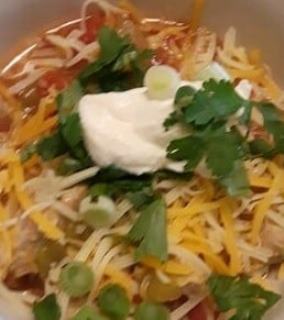
Pork Stew Rodrigo

Food is one of my greatest passions. And of all the cuisines available, my special passion is Southwest-style delicacies. This dish is guaranteed to delight your taste buds while filling your belly with a warm, happy feeling. It's simple to prepare and heavenly to devour.


Bon appetit~!


Pork Stew Rodrigo
  • 3 lbs pork stew meat
  • 2 cans diced tomatoes with green chiles
  • 28 oz diced Hatch mild green chiles (or Bueno frozen fire roasted Hatch mild green chiles chopped)
  • 8 sm or 6 med potatoes diced
  • 1/2 lg or 1 med onion diced
  • 96 oz beef broth
  • 3 pkgs. Knorr Mexican Rice mix
  • Water for rice (5 1/4 cups or per package instructions)
  • 3 Tbsp. Chile powder
  • 2 Tbsp. Cumin


Instructions:

    1. Coat pork stew meat in red chile powder and cumin. Spray skillet with Pam. Brown meat on all sides. Set aside.
    2. Dice potatoes and onion. Add to large stew pot with beef stock and cans of tomato and green chiles. Add stew meat, making sure to use a spatula to get all the pan drippings as well to enhance the flavor.
    3. Cover stew pot and set heat to medium. Gradually bring contents to a boil. Immediately turn the element back to low heat.
    4. Simmer at least one hour until potatoes are fork-tender.
    5. In a separate pan prepare the rice according to instructions.
    6. When ready to serve, place rice in the bottom of serving bowls (about halfway). Ladle out stew over rice. Serve.


Various garnishes could be made available for guests to choose. Cilantro, thinly sliced radishes, grated cheese, warm corn or flour tortillas, diced green onions, black beans, pintos, corn, and sour cream.


Click on author's byline for bio and list of other works published by Pencil Stubs Online.

View from My Back Yard


By John I. Blair

TIMBER!

Gardening by proxy can be a very frustrating occupation, but there comes a time when that’s how one does it. And at 80 years old, I’ve reached that time. I once had a big and ambitious flower garden surrounding my house, filled with annuals, perennials, bulbs, shrubs, vines and trees. A network of brick paths connected most points of the garden and there were three sitting areas where I and others could relax and enjoy the changing seasons. And I’d done all of that pretty much by myself with some help from my then young son.


But that was years ago, when I was in my 40s, 50s, and 60s. Now I’m 80 and lucky to still be able to toddle around with my cane, much less dig flower beds, squat or kneel to plant and trim and weed, or whack back encroaching vegetation. So the garden has pretty much “gone wild” on me, with the paths and patios being maintained only through the intercession of a hired yard man and the flowers surviving mostly in a small assemblage of terracotta pots up by the back door where I can reach them to water and trim.


Don’t get me wrong – this kind of gardening also brings pleasure, though mostly of the standing and looking kind. I still see the seasons changing, watch the birds flocking to feeders and squirrels scampering about in the treetops (and sitting on my kitchen window ledge to eat sunflower seeds from feeders). It’s a contemplative garden where the exercise is mostly mental.


However, sometimes mental just doesn’t cut it. Literally. A couple of plum trees, one planted 30 years ago, the other a volunteer from the fruit of the first, both died fairly recently. And have been standing out there in the center of the yard, of use primarily to woodpeckers for pecking and squirrels as a shortcut from taller nearby trees to the house. Something needed to be done; and I was quite sure it wasn’t going to be done by me.


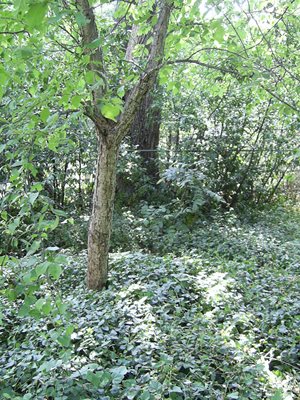
Photo of the bottom part of the trunk on the larger plum tree, before it had completely died.


Fortunately my yard man also is an experienced tree trimmer. So he offered me a package deal on the two dead trees and I took him up on the offer.


A couple of weeks ago he showed up (by appointment) with equipment and a friend to help with the cleanup work. Mind you, these weren’t little fruit orchard trees – the older, larger one was 25 feet tall and leaning against my power line that runs from the back of the yard. A potentially tricky situation. And one I wasn’t sure I really wanted to watch while it was being done. So I chickened out (chickens always get the short end of the stick in figures of speech, including this one) and decided to just sit at my desk and not look. Just listen.


I’m not a novice at having trees removed. In the 35 years I’ve lived here in this woodsy neighborhood I’ve had three full-sized shade trees plus chunks of a couple of others removed. Those jobs involved a virtual circus act, with long, tensioned cables, men in harnesses dangling from upper limbs, tightly coordinated teamwork and genuinely scary possibilities. In one case half a 90-foot-tall elm had fallen into my yard and was resting on my chimney and roof edge. In two others an equally large ash tree had fallen on my car in the driveway. Yes, that happened twice, with two different cars. Some folk are slow learners. The two plum trees were not likely to provide anything like that level of anxiety. But on the other hand my anxiety resilience isn’t what it used to be.


So I sat at my desk, determinedly looking at my computer screen and not out the kitchen window down the hallway. But listening.


Thirty minutes of more or less continuous chainsaw racket without any shouts (from the yard man) or screams (from his female assistant) and then there was a relatively low-key CRACK, CRUNCH. And the tree was down. (The bigger tree.) At that point I figured it was safe to go look.


At first glance it was hard to tell there had ever been two largish trees in the center of my garden. There was just a small tangle of tree pieces, rapidly being cut up for disposal. I had asked that the tree debris be chopped small and tossed under the huge hedge on the side of the yard where, hopefully, they would decay into new soil rather than being hauled off and wasted in the gigantic landfill on the edge of town. And so it was. By sunset, aside from a few bruised and broken goldenrod stalks, I couldn’t tell there had ever been a pair of plum trees in my yard. Sad, but also happy. They had lived full tree lives and had gone to an honorable resting place.


The yard man was also happy – no injuries and cash payment for work well done.


And now I can, for the first time in more than five years, look out into the garden and not have the centerpiece be a pair of large dead trees. Bad news for the woodpeckers (and squirrels). But they’ll find other places to feed and climb. And all of them are regulars at my feeder stations anyway.


Click on author's byline for bio and list of other works published by Pencil Stubs Online.