Sunday, February 1, 2015

Editor's Corner


By Mary E. Adair


FEBRUARY 2015

Welcome to Volumn 18 of Pencil Stubs Online! We continue bringing you varied and interesting material you can read at your leisure and in whichever format you prefer. The ezine can be found at http://www.pencilstubs.com and does not require signing in, and no comments can be added to complement an author. That can be done at the blog version, http://www.pencilstubs.net.

 Personally, your editor prefers the ezine with the larger pics and wider reading space, but the blog does show better on phones and tablets. This is the Valentine month, but only a few poems are romantic this issue.

We have one last chapter for awhile by Mark Crocker about Lexi, the feline "who must be obeyed," and a new serialized book by Denise Sebastian, "The Dark Secrets from Within." Allow yourself to be intrigued.

It is exciting to introduce new columnist Nancy Park in "Park's Place." She has experience in many fields, from spiritual to the reality of working in the business world for many years. Judith Kroll aka Featherwind's column "On Trek" poses some things to look at in a different way, while Thomas F. O'Neill, a teacher in China, addresses the tensions American television and music is creating among the youth in China.

 Mattie Lennon ("Irish Eyes") bends our ears with an Irish tale filled with humor, though somewhat dark. Mattie, himself, sent your editor a link for the hit adult cartoon "Tea with the Dead" which he wrote about in an earlier column. This link includes Mattie as one of the Voices of the deceased, in one segment. Both laughter and tears were invoked while viewing. Congrats, Mattie.

Bud Lemire shows five poems this month: "Our Journey Has Many Paths," "Crock Pot," "Heart Filled with Love," "Ideas, Truths, & Experiences," and "Life's Hard Choices." Bruce Clifford sent along "I Never Met A Girl," "I'll Sleep When I'm Dead," and "These Are The Moments."

Wendy Shepard-Kalan composed "Reunited" in memory of her nephew San Shepard. Her words convey the sorrow of loss and the blessing of memories. John I. Blair expresses some cold philosophy in "January John." His column "Always Looking - People Who Made A Difference XXVI" features the significance of the life of author Nathaniel Bowditch.

 A bow to Mike Craner whose expertise and patience allows this little ezine to present over 400 different authors over the last seventeen years, bringing their compositions of story, poetry, articles, and ongoing columns.

Click on author's byline for bio and list of other works published by Pencil Stubs Online.
This issue appears in the ezine at www.pencilstubs.com and also in the blog www.pencilstubs.net with the capability of adding comments at the latter.

Always Looking – People Who Made A Difference XXVI


By John I. Blair

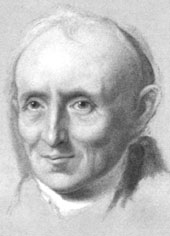
Nathaniel Bowditch

Nathaniel Bowditch (1773-1838), a self-taught astronomer, navigator, and business executive, was one of America's first scientists. His reputation is based on two books; the New American Practical Navigator – a manual for sailors that is still in print – and his translation of French mathematician Pierre Laplace's Méchanique Céleste (celestial mechanics).

 Born in Salem, Massachusetts, Nathaniel was the fourth child of a cooper (barrel maker) and shipmaster. At age 10 he went to work beside his father at a cooperage. In 1785, age 12, Nathaniel was apprenticed to ship chandlers (providers of necessary supplies to sailing ships). Living in the house of Jonathan Hodges, he was allowed to use his master's library. During the day he learned about the equipment and supplies needed to outfit sailing ships and heard stories of exotic ports and people. In the evenings he studied in the library.

Salem's sea-going merchants generated wealth that supported scientific development and instrument making. In these fields Bowditch was encouraged by three local Harvard-trained scholars: Nathan Read, an apothecary, nail factory owner, and early steam engine and paddlewheel boat inventor; John Prince, the liberal pastor of the First Congregational Church of Salem and the inventor of an air pump; and William Bentley, pastor of the Second Congregational Church. Bentley encouraged Bowditch to study Latin and, from his 4,000 book library, lent him books, including Isaac Newton's Principia Mathematica. In 1791 the Philosophical Library Society, at the urging of Bentley and Prince, granted 18-year old Bowditch borrowing privileges. With these resources he continued his readings in mathematics and natural philosophy, mastered Euclid’s writings on mathematics and geometry, and learned French by translating the New Testament with the help of a dictionary. He also constructed his own astronomical and surveying instruments.

 In 1794 Bowditch assisted Reverend Bentley and shipmaster John Gibaut in a land survey of Salem. Gibaut was so impressed with the young man's thoroughness and accuracy that he invited Bowditch to sign on as clerk on his next voyage to the East Indies. In preparation, Bowditch took up the study of sea journals and navigation techniques. Between 1795 and 1803, Bowditch sailed to the East Indies five times. He used his free time on board studying sailing charts and navigation, taking lunar measurements, and filling notebooks with observations. The first time he signed on as a clerk and second mate; by the last voyage he was master and part-owner of the ship. After selling his goods from the last voyage, he had enough capital to retire from the sea.

 Practical sailing experience combined with astronomy scholarship made Bowditch one of the best navigators in America. Newburyport publisher Edmund March Blunt commissioned him to update and revise his The American Coast Pilot, 1796. Bowditch used a 15-month stretch of shore time, 1797-98, to check the data and recalculate the tables. Building on his work on The American Coast Pilot, in 1802 Bowditch compiled The New American Practical Navigator. As secretary and inspector of voyage journals for the East India Marine Society of Salem, he had access to additional information on voyages, routes, and foreign ports. The New American Practical Navigator contained instruction in navigation, surveying directions, data on winds, directions on how to calculate high tides, notes on currents, a dictionary of sea terms, an explanation of rigging, model contracts, a model ship's journal or log, statistics on marine insurance, information on bills of exchange, and lists of responsibilities for ship owners, masters, factors, and agents. This comprehensiveness soon won it wide usage and the title of "the seaman's bible." It went through ten editions before Bowditch died.
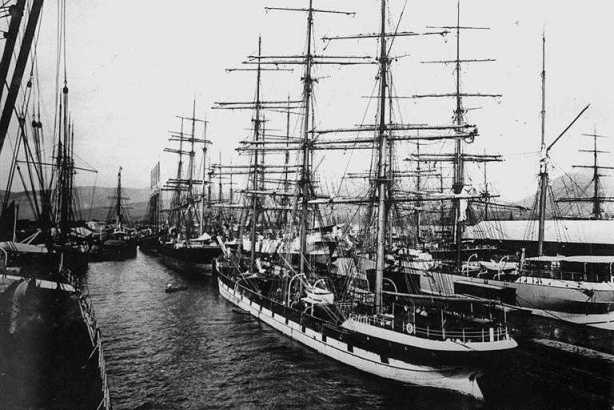

Clipper Ships similar to those in Bowditch's lifetime.
 
 In 1799 Bowditch was elected to membership in the American Academy of Arts and Sciences and was its president from 1829-1838. In 1818 he was elected to the Edinburgh and London Royal Societies. He later joined the Irish Royal Academy, the Royal Astronomical Society of London, the Royal Academies of Palermo and Berlin, and the British Association.

 Beginning in 1812 Bowditch worked on an English translation of Pierre Laplace's Traité de mécanique céleste and he wrote scientific articles on spherical trigonometry, magnetic compass variations, the earth's oblateness, celestial table corrections, and the behavior of twin pendulums. These articles appeared in the Memoirs of the American Academy of Arts & Sciences. In addition, he wrote a number of extended book reviews for the North American Review. He self-published his four-volume translation of Laplace, 1829-39, using one-third of his life savings. Complimentary copies were sent to libraries and scientists around the world. The books contained three pages of annotations for every two in the original. His protégé and editorial assistant on the project, Benjamin Pierce, went on to become a Harvard professor and America's leading mathematician. The translation trained the next generation of American astronomers.

Bowditch House in Salem

 In 1823, at the age of 50, Bowditch moved to Boston to become the actuary of the Massachusetts Hospital Life Insurance Company. He joined the Church on the Green led by the Unitarian minister, Alexander Young, and attended the Sunday evening salons at the home of his friend, Harvard professor George Ticknor. There he mixed with many of Boston's intellectuals, including William Prescott and Daniel Webster.  After his wife’s death in 1834, Nathaniel slowed down, taking more time to read poetry, history and biography. He died at 65 and was buried beside his wife under Trinity Church in Boston. Later they were reburied in Mount Auburn Cemetery in Cambridge, Massachusetts.

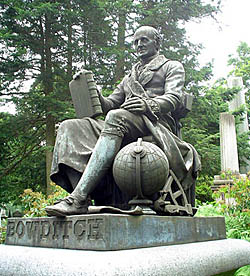
Bowditch close up and Statue

 Bowditch attended church all his life. He was reticent about his religious beliefs, particularly those that might not be universally shared. Rev. Young said, "In his religious views, Dr. Bowditch was, from examination and conviction, a firm and decided Unitarian. But he had no taste for the polemics or peculiarities of any sect, and did not love to dwell on the distinctive and dividing points of Christian doctrine. His religion was rather an inward sentiment, flowing out into the life, and revealing itself in his character and actions."

 When asked about his religious beliefs Bowditch answered, "Of what importance are my opinions to anyone? I do not wish to be made a show of. As to creeds of faith, I have always been of the sentiment of the poet (Alexander Pope, “Essay on Man”),—'For modes of faith let graceless zealots fight; His can't be wrong, whose life is in the right.'"

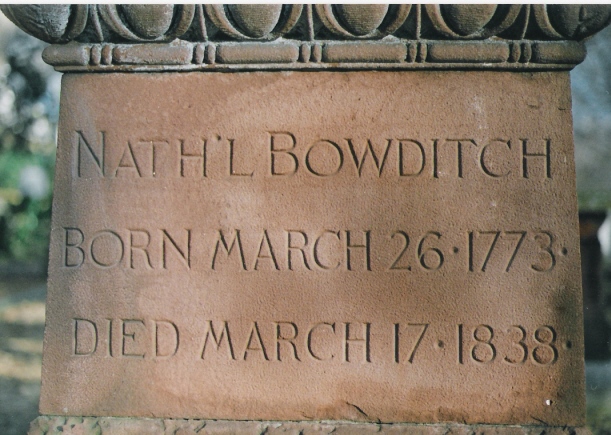
 Bowditch's grave marker shown at bottom of page.

 Adapted from the article in Dictionary of Unitarian Universalist Biography at uudb.org/articles/nathanielbowditch  Researched and compiled by John I. Blair

Click on author's byline for bio and list of other works published by Pencil Stubs Online.


On Trek


By Judith Kroll

My Trek

I was in a discussion on the internet, that I found quite interesting. Of course, I had to examine the ins and outs of the discussion within myself.
There was talk about pictures of Jesus, and how he looks, and people claiming he should have brown eyes and some say blue and or green. From his birthplace, he should be brown eyed, people said.

Now, I got to thinking how to answer that. I love to watch the TV show, ¨Ghost inside my child¨. It is all about reincarnation of little children who remember who they were in a past life.

When they come back as another person, they have different parents. In one picture they were brown eyed, and in the new life they are green or blue eyed. Some were of different races. Some were once in China and now the United states etc. Mendel's peas don't seem to matter anymore once one passes on.

When we return to spirit form, it really doesn't matter, we can be blue eyed one day and green another. I did notice that when a medium talks to those who have passed, they come to the reader in the same form they left, either brown or blue eyed, tall, bushy hair etc, so that those left here on earth having the reading, can recognize the person.

 So, if Jesus comes as a blond to someone, we should believe them, because it was their visitation!  I have come to the conclusion that everything is temporary, even our looks.

When I return to spirit, I am going to be taller.

Judith
1/24/15

Click on author's byline for bio and list of other works published by Pencil Stubs Online.

Park's Place


By Nancy Park

The "Resolution"


       It's a "new year" ..that phrase seems to precipitate ambitions of one sort or another in order to rededicate ourselves in some area of our life. This trait we seem to share, leads us into what appears to be a conscious inner inspection of different areas of our life journey. For some, it's about health and wellness, for others it may be a more deeply sought clarity of their experience here. All wonderful aspirations. Personally, I find this to be a fascinating practice, which speaks to our continued evolvement, our openness to being perhaps more positive, more compassionate, more caring of ourselves and our world around us. I admit this capability intrigues me and I am in awe at our willingness to look within.

       It makes sense when we strive to live a healthier life - of course, to be able to have this experience in the best possible way. It speaks to the human condition for us to commit to being more compassionate, more aware of others, our environment, and expressing that through acts we undertake towards that end.

       Perhaps we are mindful of how we judge others and seek to become more accepting. Some may wish to further themselves, strive to learn something new, to expand their knowledge.

       Others may choose to dedicate their time here completely in the service of others. Something often deemed the ultimate in humility.

       Many opt to dedicate their lives to their religious beliefs - forgoing a life others live for one of poverty and caring for the less fortunate among us.

       We are often taught by our caregivers/parents/teachers what has become an expected social norm, a method of what life is, and/or should be and guidelines as to who we should be, who we should strive to be, and the need to work towards acceptance by others as a hallmark of whether we 'got' it right. A 'script' for lack of a better word...to some degree, it serves a purpose - but included should be "now go find your bliss".

That said ~ what if...

       Consider that it's possible, in 'reality', (what is instead of what we are taught) that life's journey need not come with expectations. Zero guidelines. Zero judgments. Free your thinking. No 'religion'. Fearlessly look at how you move through life. Maybe it's a "one time" shot... maybe not - would it matter then, the journey you courageously chose? Would you be willing to lose relationships in order to freely chose your own path? Would you make selfless choices if you did not believe, as we've all been taught, there is a reward at life's end, for doing so? Who decides if the answers to these questions are right or wrong for you?

       Our 'caregivers' (parents/priests/rabbis, teachers etc.) pass along to us their knowledge, their experiences, the 'rote' of information that has been decided over time what is acceptable - but in the end, given their best efforts regardless of any underlying intentions, it really is not their journey.

       Whose "journey" is it? Should we be brave enough to live our lives constantly in question of what it means to us? Are we able to face convention and live a constant truth to ourselves regardless of consequences?

       What "script" are you following? Are we brave enough to take from what's been offered to us and incorporate only what serves us?

       Are we "eternal"? 'Eternal' as we have been taught, as a never ending cycle of lives - each with perhaps its own set of experiences - or is this a one time shot? Would you choose differently? Why?

       Do we have "souls"? If so - is that not just the essence of your energy? Is it that energy that is eternal?

       Or is that just another 'script'?

       So much of what we've been exposed to we blindly accept as our truth - are we being who we truly are?

       I cannot think of a more important resolution than each person finding their own truth, whatever that may or may not be. The importance of freely and consciously choosing the path you wish to follow, conventional or not, without hesitation, remorse, self judgment, expectation of heavenly rewards, fear of recrimination, completely open in each moment to whatever your 'bliss' is.

       People expect, don't be afraid to disappoint them.

       If they really 'love' you, they will remain part of your journey. Be willing to let them go.

       You can't get it 'wrong'.

       Maybe we've all journeyed together before, learning life lessons from one another - maybe not...it really doesn't matter, unless it matters to you - if you choose to believe we all have what is referred to as 'soul bonds' with one another, and that serves your journey in the highest way - then it's true for you. If not, that's ok too.

       Maybe we are here just this one time - if so, make it count...

       When your life gets "rocky" ask yourself if you are where you are suppose to be.

       I am a big fan of observation. I've gleaned alot within my life, from observing the experiences of others - and I admit a bit of gratitude for having done so. Yet that only has meaning if I choose to give it. I have found it reassuring to witness that others experience the same ups and downs, greater and lesser, as I and yet I admire their ability to persevere, and in so witnessing, I have to say it inspires me. I've also witnessed unnecessary suffering, of those who accept the views of others as to how they should live their life, that brings me great sadness. We all deserve nothing less than joy.

 It's "New Year" - Resolutions:
Be brave.
Be true to yourself.
Question always.
Believe in your inherent goodness no matter what anyone says.
Know you cannot get it wrong.
If it serves you to be kind ~ be kind.
If it serves you to be compassionate ~ be compassionate.
If it serves you to be generous ~ be generous.
Love yourself, care for your body, mind and essence.
Do/practice what lifts you.

Happy New You!

~Nanc

Click on author's byline for bio and list of other works published by Pencil Stubs Online.

Irish Eyes


By Mattie Lennon

Matt Toomey and His Jennet(s)

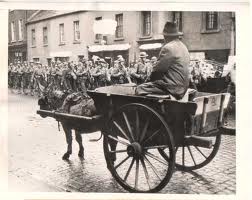
Matt Toomey was a deserted husband before it was fashionable; it’s a state that many a man would desire but it’s not possible to make a living out of it. So, Matt was a higgler, who in the early part of the twentieth century sold eggs, herrings a and such like from a jennet’s cart around Kylebeg, Lacken, Balliinastockan, and further afield.  Matt was illiterate. It’s not politically correct to say that; I should say he had learning difficulties. But I’ve said it now and I know you won’t tell anyone.

Anyway recession struck and Matt ‘s business went downhill. Now, when I say recession struck I must explain that in Matt’s case there was a contributory factor. Matt always prided himself on the freshness of his eggs. Well, he bought twelve dozen of eggs, for what seemed to be a good price, from a man called Grace in Dunlavin. Twelve dozen that’s . . e h . . .one hundred and forty four eggs. But what Matt didn’t know was that Mr Grace only had one hen. So, some of the eggs were slightly past what would now be called the “best-before date.” Matt’s customers were not impressed.

Anyway he asked, Tom, a friend of his who worked in Dublin if he could get him a job in the big smoke. The friend agreed and told Matt that he would write to him when he had a job secured. Matt reminded him that he couldn’t read and he pointed out between expletives that he certainly wouldn’t ask any of the !$%&* neighbours to read it.  “Who read the last letter you got”? asked Tom and Matt told him that he had never got a letter. “well then” said Tom with a great deal of sense, “when you get a letter you’ll know it’s from me.”   “But” says Matt “I won’t know what’s in it.”  "Oh you’ll know all right” says Tom “because there’ll be nothing in it only ‘come on to your work, Matt Toomey.’ ”

  Matt waited and he waited but no letter came. Income down to almost zero; drastic action had to be taken. He sold his Jennet, locked the door of his little cottage, made his way to Sallins and boarded the train for Queenstown in the County Cork having decided to go to America. Matt boarded the liner in Queenstown. And yes I know what you are thinking. You think you’re ahead of me, that the year was 1912 and the ship was the Titanic and that Kylebeg man Matt Toomey drowned in the North Atlantic.

Well, you’re wrong. It was 1911 and the ship was the Caronia.  The Corinia was a steel hulled ship but Matt didn’t know that. So he tapped the timber paneling (the wainscoting) and asked a fellow passenger “is there nothing between me and Eternity only that bit of a board from here to New York?” The other passenger, who must have been a bit of a go-boy, answered in the affirmative and, although the ship hadn’t left the Quay Matt said, “Head her for the ditch there; I’m getting off.” Which he did.  

He got on the train for home but it wasn’t long until a thought struck him; America was out. No sign of a job in Dublin. There was nothing for it but to go home and try to rebuild his higgling business. But he had sold his jennet. It was Fair-day in Portarlington so he broke his journey and bought another jennet. ( He would later tell people that he bought a jennet in the County Portarlington.) He spent the night in Portarlington.  

The next day was Sunday the day of the 1911 All Ireland football final at Jones’s Road. Cork was playing Antrim (Cork won by the way ;the score was Cork ; 6 goals and 6 points and Antrim 1 goal and 2 points. There were 11000 at the match. I remember it well! ) Anyway when he went to board the train for the remainder of his journey it was packed. He would manage to squeeze in but there was certainly no room for the jennet.  Matt hit on a plan; he tied the jennet to the back of the rear carriage of the train.

Matt was a man, like myself, who wasn’t used to being in the company of enthusiastic sports supporters but he settled into his journey. As the train picked up speed he asked a Cork supporter who had all the appearances of a seasoned traveller “what speed are we doing now”?

 “about sixty miles an hour, boy, I’d say” says the Corkman.

 “ be Gob” says Matt “The jennet is fairly tipping it now.”


Click on author's byline for bio and list of other works published by Pencil Stubs Online.