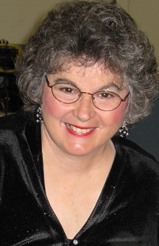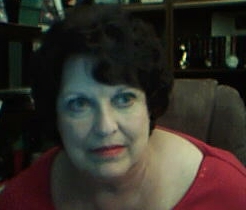
Friday, August 1, 2025

Editor's Corner


By Mary E. Adair

August 2025

“Rest is not idleness, and to lie sometimes on the grass
under trees on a summer’s day, listening to the murmur of the water,
or watching the clouds float across the sky, is by no means a waste of time.”

– John Lubbock


As my grandmother used to say "If the creeks don't rise" this month's issue will be published by 1:00 PM on the first. Our usual columnists have performed admirably. Our Dublin author Mattie Lennon even included a respectful new poem commemorating the loss of a friend. His "Irish Eyes" includes some notes on Irish activities. Thomas F. O'Neill's column "Introspective" updates us on his activities since returning from his teaching career in China. He has had so many interesting experiences over the years. His work assisting Mother Teresa is a highlight period in my opinion.


Pauline Evanosky, whose column she titled "Woo Woo" was the first to get it to me. She is so good at organizing her time and writing, and still finds time to keep active as a Psychic. Another of our very busy authors is Judith Kroll with "On Trek" who also has a lovely, upbeat and compassionate page, "Writings of Life," and manages to enjoy being in an active public choir.


I'd be remiss if I left out Melinda Cohenour, our "Armchair Genealogy" writer who also is busily lining up family members to not only be active Family Tree members, but to help with recipes and techniques for "Cooking with Rod's Family," the loving tribute to her late husband. This issue features the genealogy of her own namesake, and our Great-Grandmother, Malinda Ellen Hopper Bullard.


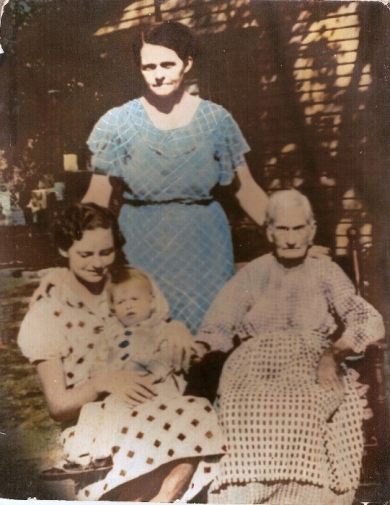
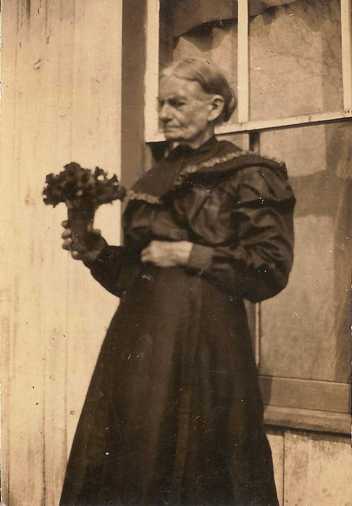
This pic is doing double duty here showing said G-Grandmother, also known as Linnie Bullard, the Songbird of the Ozarks, made popular by Vance Randolph. The latter is mentioned as well this month in Marilyn Carnell's column "Sifoddling Along," who tells about her love of reading and how it was developed. The pic also shows our mother (holding baby moi) Lena May Joslin Carroll whose poem "There's Lots of Gold in Texas" and the poem "Three Bright Stars" by her mother Carrie E. Bullard Joslin pictured behind her are also in this August eZine.


Walt Perryman's poems for August are "How to be Happy, or Not," "Good And Bad Days," and "Every Morning When I Awake." Our song writing Bruce Clifford posted "Alone in This Hurt" and "Riding The Cloud." Bud Lemire composed the wry "B*TT Call" and "Caught in The Hayes." John I Blair's "Hug" and his "Wagon Train" illustrate his skillful versatility. The second poem is clearly nostalgic as is the "Clothesline Message" from our Mail Bag.


Continuing a reminiscing feel, the article is actually a true story from yours truly, who was ten years old that August, "Remembering VJ Day, The First One."


Thanking my Co-founder and able Webmaster is well deserved but also something done by this grateful editor constantly. His urging to keep going launched Pencilstubs and his expertise has kept it thriving. Again, you are so appreciated and loved.


Watch for us in September!


Click on the author's byline for bio and list of other works published by Pencil Stubs Online.
This issue appears in the ezine at www.pencilstubs.com and also in the blog www.pencilstubs.net with the capability of adding comments at the latter.


Armchair Genealogy


By Melinda Cohenour

Malinda Ellen Hopper Bullard – or
Linnie Bullard, the Songbird of the Ozarks


    This column is devoted to the story of my namesake, Malinda Ellen Hopper Bullard, a remarkable woman whose years on this earth were chronicled, in part, by the United States Census where her existence was documented from the year 1850 (when she was just a five-year-old girl) to the year 1930 (the last Census taken before her death in 1937) a total of NINE Census enumerations. Unfortunately, as all seasoned genealogists are aware, the 1890 US Census records were damaged in a fire, but destroyed by the water damage caused in attempts to salvage those very records.


    Malinda Ellen Hopper was born 21 December 1845, almost exactly one hundred years before the birth of the child who would be granted use of her name – her great-granddaughter, the author, who was born 6 January 1946. My mother was blessed to have the opportunity of knowing her grandparents on both sides: Malinda Ellen Hopper Bullard and William Henry Bullard, maternal, and Sarah Jane Godwin Joslin and William Henry Joslin, paternal.


    My inspiration for chronicling the life and times of Malinda Hopper Bullard was the chance viewing of a movie, Songcatcher, released in 2000 but not viewed by your author until last night. The parallels of the story line of the movie and the life and times of my great grandmother were amazing and the inclusion of two of her folksong ballads, Pretty Saro, moved me to tears. My night was a restless one, seeking out the soundtrack of the movie, listening endlessly to the songs of the mountains, then dreaming of the bits and pieces known about the remarkable woman, Malinda Ellen Hopper Bullard. Rosanne Cash performs another of her ballads, Fair and Tender Ladies.


    Malinda was the second child and second daughter of John David Hopper, Jr. (b. 27 Jul 1823, Hamilton County, Tennessee; d. 19 Jul 1895, Jane, McDonald County, Missouri) and his wife, Mary Johnson Young (b. 11 Apr 1821, Lafayette County, Missouri, d. 22 Jun 1896, Jane, McDonald County, Missouri). Her mother, Mary Johnson Young was the daughter of John Young (b. 1792, Burke County, North Carolina, d. 1850, McDonald County, Missouri) and Sarah “Sally” Hopper (b. 1796, Burke County, North Carolina, d. 1854, Lafayette County, Missouri) who was the sister to Napa Charlie Hopper who led the Bartleson-Bidwell party in 1842 from Missouri to California, an historic journey memorialized in several State’s history books.
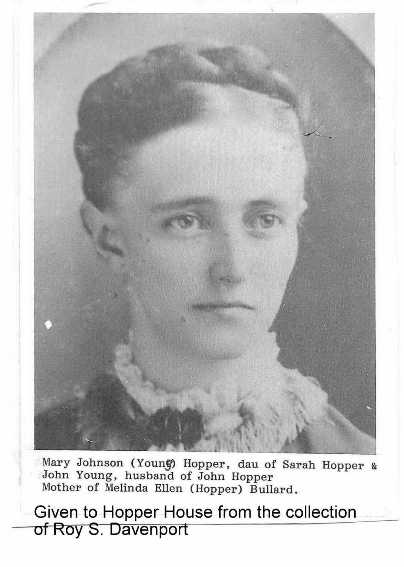


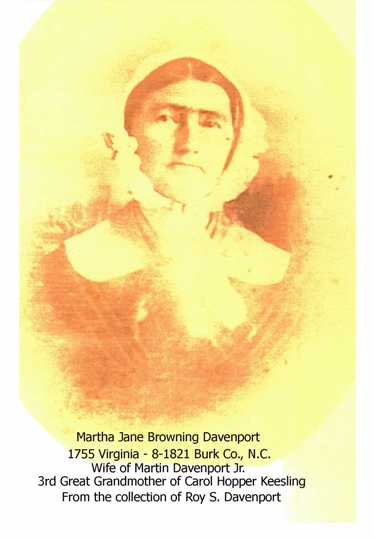
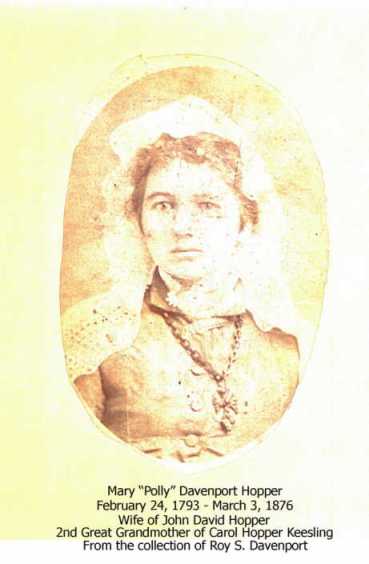
    Malinda’s grandmother, Mary “Polly” Davenport Hopper (b. 24 Feb 1793, Chattanooga, Tennessee d. 3 Mar 1876, Brushy Knob, Johnson County, Missouri) was the daughter of Capt. Martin Thomas Davenport, Jr. one of the Heroes of King’s Mountain and the subject of one of the author’s in-depth research studies provided in an earlier column. Mary “Polly” was Martin’s daughter by his second wife, Martha Jane Browning (b. 1755 in Virginia, d. 1821, presumably in North Carolina).


    Mary “Polly” Davenport was a strong influence on Malinda Hopper Bullard. She was a midwife of great esteem and a courageous woman. From another family historian’s book, the following story was told about her:


    “Ida Hopper Cox has this to say about her G-Grandmother, Mary Davenport. “My G-Grandmother was a mid-wife and used to ride all over the country on horseback and attend to the sick. We often heard my mother tell of her starting to confine some woman and an awful snowstorm came up and she lost her way. They expected to find her frozen to death. She had taken off the saddle and blankets and laid down and covered up with them the best she could, and the poor horse stood over her all night and blew his breath on her feet…she came through unharmed.”
SOURCE: Source This story was also related to our Aunt, Linnie Jane Joslin Burks, who had included the story in her handwritten family tree records.


    Like her grandmother before her, Malinda Ellen Hopper Bullard would become an herbalist, Ozark midwife, and provide medicinal care to friends, family, and neighbors.


    Malinda lived a hard and demanding life. In her early teens, the conflicts preceding the Civil War would disrupt her life. Her father was a member of the Mormon Church of Jesus Christ of Latter Day Saints and, therefore, a conscientious objector. At that time, no man was granted that right. Soldiers for either side upon finding an able man not committed to one side of the conflict or the other considered him a traitor and rendered judgment immediately. The only punishment for treason was death. Thus, John David Hopper, Jr., spent a good portion of his time in hiding in a cave near the family farm. That left the job of running the farm to Malinda. The family legend is told that early in the conflict a group of Union sympathizers or soldiers arrived at the farm. Such a visit was typically prompted by need of food, water, shelter or even care for their horses. On this occasion, the young officer in charge of the small group “took a shine” to young Malinda who was reputed to be not yet 15 years of age. After having their demands acquiesced, the Lieutenant ordered his men to “burn it.” Alarmed, Malinda pled with the Lieutenant not to destroy their farm, her mother and young siblings and all their livelihood. “Well, let’s see…a pretty young thing like you, begging for this favor, must be willing to give a favor in return, right?” With that, Malinda responded, “I’ll give ye not more than a Yankee dime, as that’s what’s said you barter in.” The Lieutenant, rather than be angered found her retort to be charmingly naïve. He said, “Well, if that’s what you have to offer, guess we just may have struck a bargain.” With that, Malinda put a boot toe into his stirrups, pulled herself up and planted a kiss upon his cheek. The soldiers were ordered to pass the farm by – and to pass the word on that it should not be harmed in future visits.


    The Census for 1860 shows the family in Pineville, McDonald County, Missouri, but the 1870 Census enumerates the family in nearby Jane, McDonald County, Missouri. The entire area of McDonald County at that time was filled with Hopper, Young, Russell, Davenport, Coffee and Bullard families. In 1880, Malinda Ellen, now age 34 was found yet to be faithfully caring for her aged parents on the family farm in Jane.


    Malinda grew up in a community largely populated by relatives. Two of her best friends were Susan Caudill, about two years younger, and her just older cousin, Eliza Coffee (Pitts) whose parents were her aunt and uncle, Elizabeth “Betsy” Hopper (elder sister to her father) and Meredith Coffee. Just after the War, the family legend is that one day the three friends were coming back from market when they saw a handsome young man with rich auburn hair and a lush auburn beard came riding by on a fine horse whose color closely matched his hair and beard. His saddle was not the ordinary “every day” saddle, but a very fancy one of leather adorned with brass fittings. The three girls each said, almost as one, “Oh, my! I think I must marry that very man one day!” And, as luck would have it – all three would, indeed, be wed to William Henry Bullard, Confederate hero of the Civil War.


    First, Susan D. Caudill, the youngest of the trio would be married to William Henry, and come to bear three sons: Jacob Alexander Bullard who would survive a mere 13 years, James Russell Bullard who would succumb as an infant, and Thomas Jeremiah Bullard who would survive to adulthood. Only two years following that third birth, Susan Caudill Bullard passed away. It is believed she did not survive a fourth pregnancy, but records have not been located to prove that to be true.


    After the death of his first wife, William Henry Bullard would take his second wife, this time wedding the recently widowed Eliza Coffee (Pitts) in 1875. By May of 1880, this second wife would die, leaving William Henry a second time widower. In June the US Census would record William Henry Bullard and his young son, Thomas just 9 years old, living in White Rock, McDonald County, Missouri. By October of 1880, William Henry Bullard and Malinda Ellen Hopper would be wed, “sitting horseback in front of Parson Scogg’s cabin.” Malinda and William Henry Bullard would have seven children of their own: Stella Lee Anice “Stell” Bullard, Vincil Clarence “Vince” Bullard, Lilvia Acenith “Lil” Bullard, Azalia Lovethia “Zail” Bullard, Mary Ester Zenobia “Nobe” Bullard, Evan Ones Bullard and Carrie Edyth Bullard.


    When Carrie married James Arthur Joslin it raised eyebrows around town. For Carrie had remained home to care for her aging parents much as her mother before her. And James Arthur Joslin was, perhaps, THE most eligible bachelor in town, dapper, tall, handsome, charming, and several years her elder. But, that was not the biggest reason for the townfolk’s interest in this prospective union but the history of the two fathers: William Henry Bullard, Confederate veteran, Democrat, Methodist and William Henry Joslin, Union veteran, Republican, Baptist. In spite of this, the wedding proceeded, but it was always said a family reunion was more like a reenactment of the Big War!


    Malinda Ellen was widowed in 1911. By 1920, the US Census would find her heading the household that included son Evan (who never married) her daughter Carrie and her little family, husband Artie and new baby daughter, Lena May.


Malinda Ellen in mourning attire – circa 1911


    The household was filled with music, as always had been true. The families of Hoppers, Russells, Youngs, Davenports and even the Bullards came from the mountains of North Carolina, Virginia and Tennessee – the Appalachian Mountains. And those mountains were filled with immigrants from Ireland, Scotland, Wales and England. The music of the Appalachian Mountain range is renowned as the origins of Bluegrass. Plaintive songs of life: struggles, unrequited love, and loss, war and conflict, and the inevitability of death. Those songs were carried down in the family by oral tradition, each generation learning the tunes and the lyrics of age-old ballads. And Malinda, known to all as “Linnie”, was born to follow in the footsteps of her grandmother and her mother before her – midwife, herbalist, medicine woman and bard. Her fame was widespread as one who knew more of the old tunes and lyrics than any other around.


    Thus, it was, that Vance Randolph would seek her out in 1926 to document what he believed to be a vanishing treasure – the folksongs of the Old Country, carried to the Appalachians and now beyond. Ironically, it is now believed the mountains of the Ozark are merely a continuation of that largest and most extensive of all American mountain ranges, beginning in the far North in New York state, to Alabama, and extending to what is now believed by some geologists to be a continuation on the Ozark Plateau. An extract from Appalachia and the Ozarks reads as follows:


The Appalachian Uplands, stretching from New York to Alabama, and the area of the Ozark-Ouachita mountains are separated by some 400 kilometers of land. They are actually two parts of a single physiographic province that have a strong topographic similarity and an unusually close association between topography and human settlement.

Early settlers, when they reached the shores of colonial America, heard tales of a vast range of high mountains to the west. As they moved into those mountains, they discovered that their elevation had been exaggerated. Only in a few small areas do the Appalachians or Ozarks approach the dramatic vistas so common in the West.

Nevertheless, most who concern themselves with such questions would agree that much of the Appalachian and Ozark topography should be called mountainous. Local relief is greater than 500 meters in many areas, and it is sometimes greater than 1,000 meters. Slopes are often steep.

The human geography of Appalachia remains closely intertwined with its topography. Without the mountains, the area would merely be a part of several adjoining areas, such as the Deep South. With them, Appalachia and the Ozarks exist as a distinctive and identifiable American region. Source


    “Vance Randolph was a folklorist and professional writer” begins the biography of this extraordinary man SOURCE His story alone is remarkable. He fell in love with the unique quality of life in the Ozarks, the incredibly beautiful landscape, and the equally unique people who had settled the area. To quote from the bio again: ‘He had first visited nearby Noel, Missouri, in 1899 as a boy while on vacation with his parents. It was then at the age of seven that he came to believe ‘the Ozark country was the garden spot of all creation.” It was the beginning of Randolph’s life-long love affair with the Ozarks of southwest Missouri and northwest Arkansas.’


    He moved to Pineville, Missouri, in 1919 and in the course of his research and documentation of the Ozarks and the way of life, learned of Mrs. Linnie Bullard, bard extraordinaire. He began visiting Linnie on her front porch and soon obtained her agreement to let him capture her ballads and folksongs on the wax cylinders he had created for this purpose.


    And, here, if you have seen Songcatcher you will recognize the incredible parallels between that movie, the musicologist heroine, Dr. Lily Penleric and our Linnie Bullard and her own musicologist, Vance Randolph. In the film, Dr. Lily visits her sister in the Appalachian Mountains and ends up falling in love with the land, the people and, most importantly, the MUSIC. She visits various people who are known to “have the music” and documents their songs by handwriting the notes and lyrics but also on a machine she creates, thus the title Songcatcher.


    Over the course of time, Vance Randolph would record Linnie Bullard’s version of many Old Country folk songs and ballads: The following is a list of songs recorded by Vance Randolph on handmade wax recording cylinders in 1926 by my great-grandmother, Malinda Ellen Hopper Bullard identified by the name by which she was normally called Mrs. Linnie Bullard. These recordings now reside in the Library of Congress. The index created originally by the University of Missouri and included by Jane Keefer in her Index.]


    Bullard, Linnie - Appearance as principal performer:

  • 1. Banks of the Nile - I (Men's Clothes I Will Put On), Ozark Folksongs. Volume I, British Ballads and Songs, Univ. of Missouri, Bk (1980/1946), p216/# 42A [1926]
  • 2. Becky at the Loom, Ozark Folksongs. Volume IV, Religious Songs and Other Items, Univ. of Missouri, Bk (1980/1946), p123/#677 [1926]
  • 3. Brown Girl and Fair Ellen/Eleanor (Brown Girl IV), Ozark Folksongs. Volume I, British Ballads and Songs, Univ. of Missouri, Bk (1980/1946), p 97/# 15C [1927]
  • 4. Come All Ye Fair and Tender Ladies/Maidens (You Fair and Pretty Ladies), Ozark Folksongs. Volume I, British Ballads and Songs, Univ. of Missouri, Bk
  • 5. Green Bed/Beds (Johnny the Sailor), Ozark Folksongs. Volume I, British Ballads and Songs, Univ. of Missouri, Bk (1980/1946), p251/# 53B [1926]
  • 6. Homespun Dress, Ozark Folksongs. Volume II, Songs of the South and West, Univ. of Missouri, Bk (1980/1946), p263/#215 [1928]
  • 7. Hunters of Kentucky (Hunter from Kentucky), Ozark Folksongs. Volume IV, Religious Songs and Other Items, Univ. of Missouri, Bk (1980/1946), p104/#666 [1926]
  • 8. Lonesome Grove (Lonesome Dove - I), Ozark Folksongs. Volume IV, Religious Songs and Other Items, Univ. of Missouri, Bk (1980/1946), p 39/#607 [1926]
  • 9. Lord Lovel/Lovelle/Loven/Lover, Ozark Folksongs. Volume I, British Ballads and Songs, Univ. of Missouri, Bk (1980/1946), p115/# 17B [1925]
  • 10. Mary Hamilton (Four Marys/Maries), Ozark Folksongs. Volume I, British Ballads and Songs, Univ. of Missouri, Bk (1980/1946), p151/# 26 [1926]
  • 11. Ocean Is Wide, Ozark Folksongs. Volume III, Humorous & Play-Party Songs, Univ. of Missouri, Bk (1980/1946), p390/#580 [1926]
  • 12. Pretty Saro, Ozark Folksongs. Volume IV, Religious Songs and Other Items, Univ. of Missouri, Bk (1980/1946), p222/#744A [1926]
  • 13. Southern Encampment, Ozark Folksongs. Volume II, Songs of the South and West, Univ. of Missouri, Bk (1980/1946), P275/#223 [1926]

SOURCE


    For my children, grandchildren and great-grandchildren, I urge you to listen to the soundtrack from this movie, Songcatcher, which includes a version of Pretty Saro by Iris Dement that is what I believe to be closest to the song my grandmother Carrie Bullard Joslin sang to me. Grandmother Carrie never believed she had the voice that her mother was blessed with, but strove to keep alive the oral tradition of this historic music. ‘Pretty Saro” has been recorded by Bob Dylan, by Doc Watson, by Judy Collins and many, many more. The current best link to hear it is a rendition on YouTube by Iris DeMent singing Pretty Saro from Songcatcher Here is the link: Pretty Saro on YouTube ris DeMent singing Pretty Saro from Songcatcher/B> I youtube.com
    Notable artists who have recorded Pretty Saro include: (Artist and Album)
    Derroll Adams – 65th Birthday Concert
    Sam Amidon – All is Well
    Judy Collins – A Maid of Constant Sorrow
    Shirley Collins and Davy Graham – Folk Roots, New Routes
    Iris Dement – Songcatcher
    Jay Munly – Galvanized Yankee
    Bob Dylan – The Bootleg Series Vol 10 – Another Self Portrait (1969-1971)
    Pete Seeger – God Bless the Grass
    Doc Watson – Home Again
    Chris Jones – Cloud of Dust
    Ashley Monroe featuring Aubrey Haynie – Divided & United: The Songs of the Civil War
    “During his Self Portrait sessions in March 1970 at Columbia Records' New York studio, Bob Dylan ran through "Pretty Saro" six consecutive times. While none of those versions made the final cut for the album, the song remained in Columbia's vault, until it was released on Another Self Portrait, a 35-track box set of songs cut for Nashville Skyline, Self Portrait and New Morning.”
    SOURCE:This is an excellent link for it provides links to the artist’s actual music.


    To add just one more bit to the mystique that seemed to surround Malinda Ellen Hopper Bullard, several years ago while researching the Bullard family, I found among thousands of entries one intriguing hit on the search engine. A lady named Marilyn Carnell living in California had obtained, by chance, a series of letters among members of the Bullard family written in the Civil War era. She did not want those letters to be lost so had posted online. I responded to her post and after a series of emails she determined I had sufficient documentation to be entrusted with the letters. She mailed a package to me of the original letters and I was, ultimately, able to identify the writers and recipients of each letter. During the course of our email correspondence, I was amazed to learn that Marilyn Carnell had a link to Pineville. In fact, when my great-grandmother Malinda Ellen Hopper Bullard passed away, the undertaker who crossed the swinging bridge to the island home where she had lived was Lee Carnell – Marilyn Carnell’s great-grandfather!


    Our great grandmother lived long enough to see the birth of my eldest sister, the Editor of PencilStubs.Online. There is a wonderful four-generation photograph of Malinda Ellen, her daughter Carrie, her granddaughter Lena May and her great-granddaughter, Mary Elizabeth Carroll. (See pic below)


    On the 4th of February in 1937, Malinda Ellen Hopper Bullard watched her last sunrise, looking out the window of her room across the wide river from the island home she shared with her daughter, Carrie. She was buried beside her husband in the Pineville Cemetery, Pineville, Missouri, among the graves of so many family members.

Compiled and Researched by Melinda Ellen (Carroll) Cohenour


Click on author's byline for bio and list of other works published by Pencil Stubs Online.


MICKEY MACCONNELL AND IRISH WAKE AMUSEMENTS


Irish Eyes

By Mattie Lennon


On July 03rd we lost one great singer/songwriter. Mickey MacConnell wrote about 400 songs and his best known is Only Our Rivers run Free which he wrote in twenty minutes when he was aged eighteen and didn’t ever change a word of it later.


The highest honour the folk music world in Ireland can bestow on any individual is The Creative Arts Award which is given annually and Mickey MacConnell was the recipient at the Fiddlers' Green Folk Festival in Rostrevor, Co Down in 2016. He found himself in the company of a host of talented people.


Mickey was inducted into a rarefied hall of fame, including the award's first winner ever, then Nobel Laureate Seamus Heaney, the legendary Pete Seeger, Ralph McTell and a host of other famous names. In other words he was with his own.


Not ever stuck for a word, the former columnist with The Kerryman newspaper said, "It's nice to get it while still alive!"


I interview him for Radio Dublin in 2001 and been the humble unassuming person that he was he gave another singer all the credit for the success of Only Our Rivers run Free, "It was a classic example of the right song, in the right place at the right time, recorded by the right artist, Christy Moore,” He emphasised to me that although it has been for decades been seen as a republican anthem it is in fact, “A cry for all the oppressed - regardless of creed.” The song was recorded more than 400 times, by artists too numerous to mention and translated into 16 different languages and the teenage Mickey was inspired by his, “ . . . frustration over the bigotry I witnessed in the meeting; with the allocation of houses to single Protestants over Catholic families." Only Our Rivers run Free was adopted as an anthem of the Civil Rights Movement, before violence erupted in Northern Ireland.


Mickey is resting in peace; he is sadly missed. I attempted to write a tribute to him to the air of Only Our Rivers run Free, but I’m afraid it doesn’t scan too well.


MICKEY.

By Mattie Lennon.

The Bellanaleck snowstorm was raging
As political storms still blew,
Protestors now tired and ageing
Defeat being now all that they knew.
‘Mid such turmoil a baby was born,
And the hopes were he’d live for to see
A minority not subject to scorn
And a province now bigotry free.

As a grown- man that child of the forties
Good Friday’s Agreement he saw,
With Ulster’s cessation of sorties-
B-Specials replaced by just law.
By then he’d gone south of the border,
To Kerry via Dublin went he
Where songs were now written to order;
Pure culture and no R.U.C.

On the day he heard his Makers voice
‘Twas July the third in twenty five.
“Oh the call? Sure I must have a choice.”
His Heaven he’d picked while alive.
When that day was gone a legend had passed.
His last thoughts before leaving? Let’s see.
With his troubles all over at last.
Yes. Why not banter with John.B.

Surely his God has now granted his wish
And perhaps bi-location of soul.
By the Erne his spirit is waiting for fish
The same at the Feale in Listowel.
Exploits of his youth documented
They’re just resting in “Peter … and Me.”
Pain-free now and sadly lamented.
While his spiritual river runs free.

* * * * * *


Speaking of death, we Irish are credited with doing it very well. The late Eamon Kelly once said that the best Irish wakes were held in America and the best American wakes were in Ireland. Be that as it may in 1921, a time of political and military unrest in Ireland Seán O suilleabháin, who went on to become Archivist of the Irish Folklore Commission, was a student near Ballina County Mayo. A local person died and Seán accompanied some of his fellow-students to the wake at night.


He was in for a surprise. He later wrote, “Within a short time, the house became more crowded than ever. More people were arriving than leaving. As far as I can recall, no other room except the kitchen was in use for the occasion. Tobacco smoke pervaded the whole place, and everybody was perspiring, as the night was close and heavy. Conversation went on in both Irish and English, and current topics were discussed in the manner usual on such occasions.” He hadn’t ever experienced a wake like it in his native Kerry. Yes, there were wakes in the Kingdom where clay pipes filled with tobacco were given the mourners and being Kerry there would be witty banter. But what mesmerised Seán and prompted him doing years of research resulting in 192 pages of Irish Wake Amusements, were the “games” which were played in the wake house. “Horseplay” would be too mild a term for most of them. Here’s an example, it’s called Cutting the Timber, “A man lay down across the threshold of the kitchen, feet outside, head within. He was to represent the saw. Two players now took hold of his feet, while two others caught his head and shoulders in the kitchen. They pulled against one another, forward and backwards as if they were sawing wood, until one pair proved too strong for the other.” Just imagine what it was like for the poor fellow playing the part of the saw. And “Cutting the Timber” was one of the milder games. It would appear that the Catholic Church wasn’t on the side of such activity. The author trawled through records of Synods of Bishops from one in the Archdiocese of Armagh in 1660 to the Diocese if Ardagh and Clommacnoise in 1903 with 11 others on dates in between. None of them recommended the carryon at wakes. The author devotes seven pages to listing his sources and an Index which left no stone unturned to inform the reader. No matter how well you think you know the Irish wake you will find revelations in this comprehensive work which you couldn’t even dream about.


Irish Wake Amusements was first published, in Irish, in 1961 and six years later in English. Thankfully, it is still available by print on demand from info@mercierpress.ie

See you in September.


Click on the author's byline for bio and list of other works published by Pencil Stubs Online.
This issue appears in the ezine at www.pencilstubs.com and also in the blog www.pencilstubs.net with the capability of adding comments at the latter.


Woo Woo


By Pauline Evanosky

What I Believe as a Psychic

There was a time when I was much younger that I had been taught to view the world as an either/or place. Either you were good, or you were bad. Either you were attractive or unattractive. Either you were smart, or you were stupid. Either you were popular, or you were unpopular.


It was simpler in those days to view life in that way.


It was soul-crushing, is what it was. Whatever my parents' opinions were, those were what I was told to believe. I have to correct that. Whatever my father's opinions were became the opinions of my mother and us kids. Like I said, it was soul-crushing before I even knew what soul-crushing meant.


However, we are always resilient. I grew to have more faith in people. I came to realize that people can be bad and then be good at the same time. I wondered how that could be. I decided they probably couldn’t act any other way and were to be pitied. It’s difficult to extend a helping hand to an offensive person, but I did run into a lot of them. As does anyone else.


As an adult, I began to see that I could set boundaries and not take it upon myself to become the patsy of narcissists.


These days? If I can identify somebody as a narcissist, I will go out of my way to remove myself from them as quickly as I can, even if it means quitting a job. Yes, you can live with a narcissist, but it involves you being on the offensive to try to call them out every time they try to manipulate you. It is tiring, but it can be done. I don’t have it in me to do that anymore. Nope. Go your way, you narcissistic person, and have a nice life with somebody else.


In any case, now I am a psychic medium channel. What does that mean? It means I talk to Spirit, to dead people, and can relay any messages to folks who come to me for a psychic reading. I’ve been doing this since 1993, having known it was possible for a good five years before that, and have been interested in that way of being since I was in high school, around the time I realized what my father believed was not what I believed.


So, it’s been a while since I’ve been interested in psychic things.


What is interesting to me, though, is that the messages that Spirit gives to the ones left behind have absolutely nothing to do with regret. They will not help you find lost articles. They will not explain themselves in ways that would either comfort or relieve the clients I get. I was surprised myself when it began happening, and it was then that my education of things psychic and spiritual began to grow.


So, yes, they are okay. No, they don’t want you to do anything. No, they are not sad when you make stupid decisions. Yes, they love you. Yes, they love you now when they once might have hated you. Yes, they are always in touch with you, with your family, and with what you are doing. The connection never stops. It is always there.


My own personal lessons in forgiveness began when I spoke with my father after he had passed. I still occasionally get angry at him because the road he showed me was a tough one to follow. I’m still falling into ruts at times, but I recognize that we are friends again.


Another thing that happened when I became psychic was that my faith grew tremendously. I once asked my spirit guide if anybody ever heard our prayers. He said something that startled me. He said every single one of our prayers is heard. He did not say they were considered, answered, or referred to somebody else. It is our responsibility to handle the tough aspects of our lives. There will not be any sort of divine intercession. Until there is.


I also learned about healing with energy. As a Reiki practitioner, I learned that we can send healing energy to people halfway across the world. We can ask for assistance from other Reiki practitioners or energy healers anytime we want. You don’t have to actually have been introduced to them for an effective exchange of energy to happen. However, you can never force healing energy upon somebody who doesn’t want it. That’s the rule. Or, at least, that’s what they told me. I have held to that rule and in my prayers I include the idea that this healing energy I am sending someone’s way can be accepted or rejected by the person. It’s free will.


I can remember once being irritated that a religious group in town was selecting names from the phone books, back when we had those, and baptizing people in their faith.


Irritated and amused all at the same time. How dare they? Well, how dare I take it upon myself to pray for somebody if they aren’t aware I’m doing it? So, I was sort of in a quandary until my spirit guide said that was why nuns prayed all the time. They weren’t necessarily praying for themselves; they were praying for whoever needed it. Sometimes people they knew. More often than not, I think, just for anybody who could use some prayer. That was what nuns did. They prayed.


Another aspect of healing is that not only must the person be willing to accept the healing, but they also need to take the necessary steps for it to occur. For instance, somebody who has manifested a broken heart while also frequently being in a drunken stupor. They are an alcoholic. They are drinking their problems away. They say they want a healing. Sure, but they are still going to have to go into psychotherapy to help them through their addiction. They are still going to have to stop drinking alcohol or using drugs. Anything that numbs a person is a weapon in an alcoholic’s hands. Likely, they will learn all sorts of things as they spend the rest of their life being a non-drinker. Probably, they will end up being a teacher for others in the same boat. Who knows? Healing can sometimes be much more difficult than our bones physically knitting together.


Something else I learned when I became a medium and a psychic channel. I differentiate the two because to me, a medium is somebody who is passing along messages from loved ones who have passed on, and a psychic channel is somebody who talks to spirits, which may include loved ones, but definitely includes those who act as teachers, which is a lot of people. I say people, but you could also be talking to animals. They go to Heaven, too.


If you want to learn more about psychics, spend some money and go to one or two. Each of us is unique and, like all people, interprets the world through our individual beliefs. There are psychics who utilize a bunch of rules like grounding yourself, wearing specific colors, or burning sage, all sorts of things to help the connection along. Also, tools of divination can be used to give psychic readings. I’m talking about pendulums, Tarot, or Runes. I have no rules other than not to ask the same questions repeatedly. That is tiring.


My reasoning is that if I learned how to do this, anybody can. You don’t have to be special in any way. This is one of your senses. You know something else? It wasn’t until I began to channel that I realized how much Spirit moves through our lives without us being fully aware of it.


It's not magic, yet it is magic.


Thanks for reading. See you next month.


Click on the author's byline for bio and list of other works published by Pencil Stubs Online.
This issue appears in the ezine at www.pencilstubs.com and also in the blog www.pencilstubs.net with the capability of adding comments at the latter.


Cooking with Rod's Family

My daughter must have been dreaming of the Caribbean! She created this delightful Brown Sugar-Jalapeno Roast and paired it with a medley of delicious veggies with that island flare.

Tasty, exotic, easy to prepare, this is a dish that will deliver compliments to the chef.

Bon appetit ~!

Lissa's Brown Sugar-Jalapeno Roast
and Island Veggies


Ingredients:

    * 8 lb beef roast
    * Olive oil, to moisten the roast and facilitate brown sugar rub to adhere
    * 1 cup brown sugar
    * 3 lbs small sweet potatoes, peeled and cut in about 1/4" slices
    * 2 cans cut green beans (drained)
    * 1 bunch carrots, peeled and cut in diagonal slices, about 2" long
    * 1 mild jalapeno diced, with membrane, seeds and stem removed.
    * 2 Tbsp. Worcestershire sauce
    * 1 (20 oz.) can sliced pineapple, add the juice to roast
    * 2 cups water, divided for use. (Add more water later if the roast appears too dry.)


Instructions:

    1. Preheat large Slow Cooker. Or, if planning to roast in oven, preheat to 350° F.
    2. Wash, rinse and pat dry beef roast. Remove any excess fat.
    3. Spray or pour olive oil on roast. Rub oil on all surfaces.
    4. Rub brown sugar all over the roast. Place roast in Slow Cooker and add 1 cup of water. Cover, set on High and let cook for about 2 hours before adding vegetables in order shown below.
    5. Place sweet potatoes around the roast, cover and let cook about 45 minutes.
    6. Add drained green beans around the roast. Top with carrots. Sprinkle minced jalapeno on top.

    If needed, add more water. Sprinkle Worcestershire sauce around over roast and some on the carrots.

    Cover and cook about 15-20 minutes more.

    7. Add rings of pineapple on top of roast and vegetables.

Add water. Cover and cook to heat pineapple and permit flavors to blend.

* * * * * *


An entire meal is ready to serve once the roast is cooked to the degree of doneness you prefer. All that is needed to perfect the dinner is the addition of hot, crusted bread and the drink of your choice.


Enjoy!!


Click on the author's byline for bio and list of other works published by Pencil Stubs Online.
This issue appears in the ezine at www.pencilstubs.com and also in the blog www.pencilstubs.net with the capability of adding comments at the latter.


Introspective


By Thomas F. O'Neill


I moved back to my hometown, Shenandoah, Pennsylvania, in 2002, after being away for nineteen years. The transition of moving back then was quite difficult for me because the town I remember from my youth is quite different from the town as it is today.


My hometown is in the heart of the Pennsylvania coal region. When the coal industry was booming, Shenandoah’s population was approximately thirty thousand. The mines, however, are no longer open; they closed in the early nineteen-fifties. The closing of the mines caused the population in Shenandoah and the coal region as a whole to decline. Today, fewer than 5,000 people live in my hometown. The average income is somewhere around seventeen thousand per year, and the majority of the people are on public assistance. The town’s poverty has also resulted in higher crime and drug use among the youth.


Forty-four percent of our town’s population is made up of senior citizens. The seniors are very vocal and negative about the town's decline as well. However, I enjoy listening to their stories of what the town was like before I was born, when various Department stores lined the main street. I was very shocked and saddened by the number of vacant lots and vacant buildings in my town.


What bothers me the most is that the majority of our town’s teenagers congregate on the main street out of boredom. Most if not all, of our town’s youth will move out of the coal region once they graduate high school or college. They will move to where there are high-paying jobs and better employment opportunities. This is the main reason why the outward migration is greater than the people moving into our region.


I was contemplating moving away from the area once again, but I decided to stay to cultivate ways of teaching the history of our town to the younger generation. Some of the friendships I have made over the last five years have also helped me become more involved in my community.


I have always been intrigued by our town’s history. The history was mostly passed down to me orally by some of the miners' widows and my grandparents. They were proud to live in the coal region because of its rich ethnic diversity and heritage.


I was very bitter about the change I saw in Shenandoah because I felt people were losing touch with our town’s past. I tried my best, however, to accentuate what is positive in our community rather than dwelling solely on the negative.


It wasn’t until a tragic event occurred on August 4, 2006, that my perception of the region changed in a very dramatic way. On that date, a fifteen-year-old boy, Aaron Kegolis, was severely injured in an auto accident. His girlfriend, who was driving the vehicle, lost control of her car after a blowout of one of the tires. The car rolled over an embankment, and Aaron Kegolis, who was a passenger in the car, was thrown from the vehicle. He suffered a severe head injury. While he lay in a coma, I witnessed the entire community reach out to his family.


That auto accident was truly tragic it changed not only Aaron’s life but his family and friends' lives as well. His family told me that he has a long road of recovery ahead of him. The difficult road that Aaron is on is being made a bit easier, though, by the outpour of love and affection from his family, friends, and the entire community.


The coal region is known for being economically depressed from lack of jobs and resources, but the community’s concern for Aaron only goes to show that the coal region is still rich with heart and soul.


The entire community has come together and organized fundraisers for Aaron's family. There were softball tournaments - twenty-five teams played each other which raised a lot of money for Aaron. There were dances organized by the high school students. Concerts were held and t-shirts with - “Aaron bringing a community together” - were sold. Along with various other events that were organized over the last six months.


These fundraising events did much more than raise funds for Aaron. They brought our entire community together out of compassion for one of our own.


We have a tendency to judge one's generosity in terms of dollars, and there is no doubt that a lot of money has been raised to help Aaron's family. Those monetary donations are truly needed to aid Aaron with his recovery. What will never be forgotten, though, in the hearts and minds of our community are the small acts of kindness, because this kindness has a profound effect on the giver and the receiver, but most of all on our entire community.


Most people think that little acts of generosity are insignificant, but every little kind act resonates through our community. When we reach out to enhance the life and well-being of a person in need, we in turn enhance our own lives.


Aaron has shown everyone that he has a loving family and a lot of friends who truly care for him. It was their collective collaboration of love that brought the entire community together in a way that I have never seen before, which is truly heartwarming. It makes one proud to live in a community that cares.


Our community, with its outpour of love and affection, has shown Aaron and his family that you can measure the true worth of a person's character not by what they amassed over the years but by what they give to others. Our greatest gifts in the coal region are not measured monetarily because they come from the heart. Those heartfelt acts of generosity for Aaron resonate through our community like enlightening words of love, which are far more precious than monetary gifts.


The truest heroes in our community are the ones who reach out to those of the least influence - the ones who do not have the means to return the favor. The coal region has a lot of heroes, and they are the ones who have the profoundest effect on our community. It is through their kindness and love that they will always be remembered.


Always with love,
Thomas F O'Neill

    Email: introspective7@hotmail.com
    WeChat - Thomas_F_ONeill
    Phone: (410) 925-9334
    Skype: thomas_f_oneill
    Twitter: https://twitter.com/Thomas_F_ONeill
    Linkedin: https://www.linkedin.com/in/thomas-f-o-neill-6226b018/
    Instagram: https://www.instagram.com/thomas_f_oneill/
    Facebook: http://facebook.com/thomasf.oneill.3/


Click on the author's byline for bio and list of other works published by Pencil Stubs Online.
This issue appears in the ezine at www.pencilstubs.com and also in the blog www.pencilstubs.net with the capability of adding comments at the latter.


Sifoddling Along


By Marilyn Carnell

I learned my ABC’s when I was six years old. This would be shocking today, but in 1946 when I entered first grade (there was no kindergarten at the time), I was stunned to find that my friend, Mary Rowan, and others had learned this special code. I went home in outrage. It seems that my father, who was a school superintendent, didn’t believe in homeschooling at the time. Thus, this gap in my learning. It was especially odd since he had taught himself to read at age 4. Perhaps he thought I should do it on my own. I will never know the answer to that question.


At any rate, I learned my ABC’s and quickly learned to read. This opened up a whole new world to me. For many years I read voraciously and today I would like to mention books that made an impression on me.


First grade introduced me to the world of reading with the Dick and Jane readers. How I loved discovering words and the simple stories.


I could read! What a thrill.


In the second grade the teacher read to us for a short time each day. My favorite was a scary story about Lazy, Lizy Lizard. The lines: “Lazy Lizzy Lizard, I’ll cut out your gizzard and throw you in the lake.” Sent a delicious shiver down my spine.


When I was about 9, a county library was established and I was given free rein to read any book I wanted except the works of Vance Randolph, a collector of folktales. His books were kept behind the librarian’s desk as they were deemed “dirty” and unsuitable for young minds. (I now collect his books.)


I was 11 when I read Gone with the Wind, A friend informed my parents about my questionable choice and asked if they approved. Apparently, they did as I was not censored in my reading list and I worked my way through the library shelves. I devoured the Civil War books by Bruce Catton bodice rippers (apparently not thought to be “dirty”) murder mysteries, historical novels lives of English kings. I even, read a set of encyclopedias. Anything with the written word on it was fair game. I once missed a plane as I was so engrossed by the book I was reading.


In college I read Greek mythology, science fiction, and classic literature like War & Peace.


Over the years several books stand out as memorable. The Bridge of San Luis Rey, A Confederacy of Dunces, the Tolkien books, Dune, A Canticle for Liebowitz, Dr. Zhivago, The Double Helix, Animal, Vegetable, Miracle, a mixed bag, to be sure.


These were a few of the books that had a lasting impression among the thousands of stories I have read in the past 79 years.


Click on the author's byline for bio and list of other works published by Pencil Stubs Online.
This issue appears in the ezine at www.pencilstubs.com and also in the blog www.pencilstubs.net with the capability of adding comments at the latter.


On Trek


By Judith Kroll

Until You Walk in Other's Shoes


You don't have to walk in another's shoes. You just have to FEEL their energy.


You see a dog on the side of the road and he was abandoned. Hungry, thirsty and afraid you help him out. You cannot imagine his pain at being thrown out.. . Abandoned. He feels your love. He feels you care. And you feel his.


Now with the rushing waters of the Texas banks, You hear stories. You see pictures of those who lost their lives.


Now feel the energy of that father that tried to reach his daughters but couldn't because the swift waters swept his two beautiful daughters away.


How does Daddy feel? He will never be the same.


We can send love to that daddy and his children as we read the story. Love will reach him. He doesn't need to know who that love came from, but he knows love is being sent, because that wonderful daddy can feel it as well.


Because we have the power to feel the energy of others, we can help change the world. We are NOT limited. No we cannot fly to help our brothers and sisters being removed from their homes by ICE ..BUT...Remember this.....


OUR LOVE FLYS Where we send it. It reaches our target. It flows from our souls, to the souls of those who are part of us, because as people,


We truly are ONE.
July 14, 2025
Love,
Judith


Click on the author's byline for bio and list of other works published by Pencil Stubs Online.
This issue appears in the ezine at www.pencilstubs.com and also in the blog www.pencilstubs.net with the capability of adding comments at the latter.


Remembering VJ Day, The First One


By Mary E. Adair

(Originally published in Hobbie$, Etc., September 1995)

This is a mild mid-August day in 1945, but sirens are screaming. Mother stands bent over with one ear near the cloth-covered speaker in the base of the more-pretty-than-useful radio. She frantically spins the dial, searching through the static for a legible announcement, or warning, or explanation -- to tell us if we are to do anything.

I listen, terrified while exciting pictures of newsreels of blockbuster bombs falling from planes flash through my mind. Are we being bombed? Maybe the target is the nearby airfield -- maybe my school! I love my school, my friends, my teacher . . . Heaven forbid that it should be my school about to explode into dust and rubble!

Suddenly, Mama stands upright, then bracing her hand on the curved and polished wood of the waist-high console, she beams, "Oh! Thank God, Girls, thank God! What we've all been longing for has happened -- the War is over! Oh! Thank God! I wonder if your Daddy has heard yet. I must call Mother. Now your Uncle Jackie can come home!"

"Is the War really, really-truly over, Mama? Can we tell Billy?"

"Tell the world, Girls, tell the world!" Mother heads for the phone planning to get her call in before all the lines are jammed, and declares aloud that she hopes she gets a good operator she likes so they can discuss this wondrous news while waiting for the call to grandmother to reach all the way to Missouri.

Gleefully, we girls, my two sisters and I, run out to the green, grassy, front yard. Here comes Billy, shouting our news -- he always knows everything first! I grab his hand, and we join hands with my sisters, the four of us skipping in a circle in the bright sunshine, chanting, "The War is over! The War is over, and tomorrow we get our bicycles!"

We had saved our allowances, for the most part, fed by the promise that when the war was over we should have our money all ready for the dreamed- about-bicycles. I knew what my bike would be -- a powder blue girl's Schwinn!

I had already named this dream. I, who had outgrown dolls and naming them, had a tom-boy's idea of what this bike would mean in my life. The "Blue Devil" was going to be mine because God (who my mother was still thanking, her voice flowing through the open window) had seen fit to end the War!

The guys, Billy and the others, all came to play in our yard -- where Daddy Jack had built pipe-iron swing sets with trampolines and trapeze bars and strong swings with chain supports right next to the ten foot square sandpile furnished with sand from the dunes east of town. These boys would have to let me now. Yes, the guys would have to let me join their gang once I had my own bike.

(Editor's note: They didn't.)

I blush now to remember that V-J Day, the sixteenth of August, 1945, and the selfishness of childhood desires.

I can still feel the heart-in-the-throat emotion evoked partially by relief that we were not being bombed, but mainly by the misunderstanding that factories could immediately produce and deliver our long anticipated bikes.

But by the time the plants re-tooled from the manufacture of war supplies and were once more building and selling bicycles, I had shed my tomboy stage, and looked on boys from a far different perspective. I still cherished my powder blue Schwinn, but used it to ride to a girl chum's house to discuss serious subjects like when would we be allowed to start dating, or shaving our legs, etc.

* * * * * * *

Editor's Note: Although August 15, 1945, marked the surrender of the Japanese forces, the official Victory over Japan, VJ Day was named as September 2, 1945, by President Truman when a formal surrender ceremony was held in Tokyo Bay aboard the USS Missouri between Japanese dignitaries and himself.

©Mary E Adair Originally published in Hobbie$, Etc., September 1995


Click on author's byline for bio and list of other works published by Pencil Stubs Online.


Wagon Train


By John I. Blair

By wagon train my grandfather went
From Nebraska to Oklahoma in 1886.

I once imagined white canvas tops,
As bright as schooner sails,
Brave men, the women strong,
Striding beside fat cattle,
Bearing civilization along
Into the new land.

Well, they had cattle, sure enough,
And bawling calves, flies, ticks.
Weary, filthy from the endless dust,
They might sicken, die young.
The roads, just holes, rocks, mud,
Were crude tracks.
Wagons, soaked in streams, baked
In the sun, fell apart from shaking.
How they made it I do not know.

And the civilization they wrought?
Well, I’ve often thought about
How that turned out.

But they brought me into being
Just by hauling all their dreams,
Inevitably, inexorably, down
Those rough trails into the present.

©2003 John I. Blair


Click on the author's byline for bio and list of other works published by Pencil Stubs Online.
This issue appears in the ezine at www.pencilstubs.com and also in the blog www.pencilstubs.net with the capability of adding comments at the latter.


Every Morning When I Awake


By Walt Perryman

Every morning when I awake,
I thank the Lord, for my sake.

I know, I only have two choices today,
And that would be God or Satan’s way!

I also know that today I can win or lose,
And it depends on the one that I choose!

Your day depends on the choice you make,
It’s time to choose which one you will take?

©July 23, 2025 Walt Perryman


Click on the author's byline for bio and list of other works published by Pencil Stubs Online.
This issue appears in the ezine at www.pencilstubs.com and also in the blog www.pencilstubs.net with the capability of adding comments at the latter.


Three Bright Stars


By Carrie E. Joslin

The stars are shining so brightly tonight,

    Three separate ones shine with a brilliant light
      Shining thru’ darkness their light to show,
        They remind me of three sweet girls I know.
          They shine thru’ my window and beacon me,
            And I call them, “Jacquelyn, Mary and Noralee.
Jacquelyn is a small bright, glittering star,
    Never still but sparkles like a crystal bar.
      This small star is shining with all of its might,
        Casting a radiance over the night.
          There are so many stars dear, but none like you,
            That shine in all of the beautiful blue.
As I watch this small star, and it shines down on me,
    My own darling Jacquelyn so plainly I see.
      Then, I turn my eyes from this small bright star,
        To another so near and yet so far.
          A star that shines with radiant light,
            Sending out rays through the darkest night.
This star is Mary--so sweet and mild,
    My precious, my Darling, my first grandchild
      I gaze and gaze on this beautiful star,
        It seems so near and yet is so far.
          This star , like Mary, hides its thoughts from me,
            Only those beautiful eyes I see.
From these two bright stars I turn to see
    A gay happy star laughing and winking at me.
      This star is Noralee, so coy and wise,
        Laughing and dancing and rolling those eyes.
          A changeable star, yet it whispers low,
            To say it will love me where ever I go.
And, I smile as I look at you beautiful star,
    Shining like Noralee where ever you are.
      The world is made up of darkness and light,
        God made the day and God made the night.
          He made every thing in this beautiful world,
            Each bright shining star, and each precious girl.
Those three special stars that shine in the blue,
    Those three sweet girls so good and true.
      I will bid you all a fond good night,
        For I may not see you in the morning light.

          © circa 1944 Carrie E. Joslin


          Click on the author's byline for bio and list of other works published by Pencil Stubs Online.
          This issue appears in the ezine at www.pencilstubs.com and also in the blog www.pencilstubs.net with the capability of adding comments at the latter.


How to Be Happy or Not


By Walt Perryman

Can you be angry and happy, at the same time?
Do you believe that staying angry is a Godly crime.

Can you be happy if the way that you live is a lie,
Some of us live our lives angry and don’t know why.

Many of us have bad memories that seem to never go away.
And the only way to happiness is through God when we pray.

Without God you’ll never forgive or forget what bothers you.
By giving 100% to God, you’ll receive the happiness you’re due.

So, if you are angry a lot,
You know how to be Happy, or not.

©July 21, 2025 Walt Perryman


Click on the author's byline for bio and list of other works published by Pencil Stubs Online.
This issue appears in the ezine at www.pencilstubs.com and also in the blog www.pencilstubs.net with the capability of adding comments at the latter.


There's Lots of Gold in Texas


By Lena Carroll

(Originally published in Hobbie$, Etc. circa 1996)

The sun shines down on Texas;
On all the wide bright land,
On many a high rocky mountain
On many a mile of sand.

It beams on fields of Bluebonnets
Standing up brave and tall--
Growing where God did plant them
Where He caused their seed to fall.

On smooth white carpets of Daisies
Or on cactus thorny and wild--
Then on to the bold Indian Blankets,
Or on Buttercups sweet and mild.

The sun shines down from Heaven
Blesses the Lone Star state,
With its rays of golden beauty
Cleanses each heart of all hate.

For how could a man be bitter?
Wicked, scheming, or vile?
When all over our country
The bright sun's gold is piled.

The air is clean and golden
Washed by the Gulf's mild breeze;
And high up in the mountains
Frost paints gold on all the leaves.

The sand is spread beneath us,
Pale golden in the sun--
Telling of the many eons
The course of man has run.

In the gold of Texas
The heart of man is alive--
With room to dream and ponder
And towards his goal to strive.

Lena May Carroll, "There's Lots of Gold in Texas" copyright 1940

B*tt Call


By Bud Lemire

I never made a Butt Call, many people think it's alright
Mine is in my side pocket, and it's on the charger at night
Some tend to make those calls, all of the time
They must move around, while they sit on their behind

So, what if your phone was in your pocket near your chest
Could it be a call, that comes directly from your breast?
If you're a woman, and you carry a purse
You won't have, the “Butt Call” curse

You can shut off your phone for awhile
Then you won't worry, your Butt won't dial
It's better to, find a better place for your phone
That way, the Butt Calls will be left alone

I put my phone, in my left side pocket
My phone opens apps, while my feet walk it
I'll hear a voice, as I'm walking along
Sometimes it'll be, some commercial song

I've seen some really nice Butts, and wouldn't mind a call
If it's by accident, I'd rather you didn't call at all
I'd rather not get a call from someone who is snooty
A Butt Call is nice, but then there's a call called the Booty

©July 24, 2025 Bud Lemire

                        Author Note:

Seeing people with phones next to their Butts, makes me wonder.
Do they sit on them? Do they remember to take them out,
before they sit down.
A Butt Call, also known as a pocket dial, is an
unintentional phone call made when a cell phone is in a
pocket or bag and accidentally activates the call function.
This typically happens when the phone's buttons or
touchscreen are pressed by body movement or other objects,
causing the phone to dial a number without the user's
knowledge. The meaning of Booty Call is a communication (such as a
phone call or text message) by which a person arranges
a sexual encounter with someone.

Alone in this Hurt

By Bruce Clifford

Pictures like icons.
Heroes in dirt.
Desktops and tagalongs.
How my heart hurts.

Freedom in passing.
Moments on wings.
A love everlasting.
Broken on a string.

How many lifetimes have been through to get to here?
Have we held each other before all this universal fear?
I really have no idea.

Roadsides and cyclone.
A primordial parade.
Frosted Ice cream cones.
Memories we saved.

Moment’s everlasting.
Where nothing forgives.
Heatwaves and fasting.
Many lives lived.

How many lifetimes have been through to get to here?
Have we held each other before all this universal fear?
I really have no idea.
There must be more.
There must be more.
There must be more than this.

Memories never faded.
Blue sky then gray.
Feeling alone and jaded.
Nothing more to say.

Pictures like icons.
Heroes and dirt.
Centuries of memories.
Alone in this hurt.

©7/8/2025 Bruce Clifford


Click on the author's byline for bio and list of other works published by Pencil Stubs Online.
This issue appears in the ezine at www.pencilstubs.com and also in the blog www.pencilstubs.net with the capability of adding comments at the latter.


Hug


By John I. Blair

How can
Such a
Simple
Act be
So
Complicated?
We wrap our arms
Around each other,
Pressing close
As much as feels
Appropriate
For the occasion, and
Suddenly it’s
Mother
Father
Sister
Brother
Friend
Lover
Security
Community
Peace
Passion
Greeting and Good-Bye—
Everything it means
To be human
And vulnerable
And generous
And alive
Together.

©2002 John I. Blair


Click on the author's byline for bio and list of other works published by Pencil Stubs Online.
This issue appears in the ezine at www.pencilstubs.com and also in the blog www.pencilstubs.net with the capability of adding comments at the latter.


Clothesline Message


By Mail Bag

A clothesline was a news forecast, to neighbors passing by,
There were no secrets you could keep, when clothes were hung to dry.
It also was a friendly link, for neighbors always knew
If company had stopped on by, to spend a night or two.
For then you'd see the "fancy sheets", And towels upon the line.
You'd see the "company tablecloths", With an intricate design.
The line announced a baby's birth, from folks who lived inside,
As brand-new infant clothes were hung, So carefully with pride!
The ages of the children could, could be so readily known
By watching how the sizes changed, you’d know how much they'd grown!
It also told when illness struck, as extra sheets were hung;
Then nightclothes, and a bathrobe too, haphazardly were strung.
It also said, "On vacation now", When lines hung limp and bare.
It told, "We're back!" when full lines sagged, with not an inch to spare!
New folks in town were scorned upon, if wash was dingy and gray,
As neighbors carefully raised their brows and looked the other way.
But clotheslines now are of the past, for dryers make work much less.
Now what goes on inside a home, Is anybody's guess!
I really miss that way of life, it was a friendly sign
When neighbors knew each other best... By what hung on the line.

Circa 2020 Anonymous  

Good or Bad Day


By Walt Perryman

Sometime today if you are feeling down,
Take a deep breath and take a look around.

Evidently, you’re alive and on Facebook,
Try to be positive when you take a look!

So, if you have a good day or bad day,
You can ask God to help you either way!

Even if your day is bad and you still survive,
Thank the Lord for allowing you to be alive.

God will give you the strength to Cowboy-up,
Now it is time for you to suck it up, buttercup.

©July 30, 2025 Walt Perryman


Click on the author's byline for bio and list of other works published by Pencil Stubs Online.
This issue appears in the ezine at www.pencilstubs.com and also in the blog www.pencilstubs.net with the capability of adding comments at the latter.


Caught In The Hayes


By Bud Lemire

Caught in the Hayes, of what's right and what's wrong
I've been held on a leash, they just pulled me along
I thought it was love, but I knew that couldn't be
Each one of those forty Sarahs, wanted money from me

Oh yes, I carried on and I was a fool, and I gave in
As time went on I resisted, but I still couldn't win
I guess I was dreaming, of a future to come
What I proved to myself was, I was so dumb

Those women out there, just wanted my money
For that price, it was easy for them to be my honey
The funny videos with the southern accent, that I always see
Were just there to lure me in, and take my money from me

Don't be scammed like I was, try to be wise
It's not love they want, behind all those lies
They want to drain, your bank account dry
Once they do that, it will be their turn to fly

If there's forty Sarah Hayes messaging you, with the same face
They aren't from alternate worlds, something's out of place
Hold onto your money, and don't you let go
This is a warning, something that you should know

©July 11, 2025 Bud Lemire

                       Author Note:

Yes, I was a fool. But I learned something as well.
It's a cruel world out there on the internet. Behind
the screen, is a world built on lies and greed and
people want to take advantage of those who believe
them. So as you read this, and if you are looking for
love, remember, it is not love if they ask for money.
To me, love is given freely. Love is earned and it
takes time as it grows stronger and stronger.


Click on the author's byline for bio and list of other works published by Pencil Stubs Online.
This issue appears in the ezine at www.pencilstubs.com and also in the blog www.pencilstubs.net with the capability of adding comments at the latter.


Riding the Cloud

By Bruce Clifford

We see the world from when we were young.
A different place.
You can’t erase the memory of you and I.

We touch the air that we taste and see.
A cosmic eye.
Across the divide and all the places in between.
All the traces of this cosmic extreme.

Dancing across the open sea.
Riding the cloud of gravity.

We see the world from when we were new.
A safer place.
You can’t escape what’s left of us.

We touch the earth and the immortal space.
A familiar face.
You can’t erase the memory of you and I.

7/2/2025 Bruce Clifford


Click on the author's byline for bio and list of other works published by Pencil Stubs Online.
This issue appears in the ezine at www.pencilstubs.com and also in the blog www.pencilstubs.net with the capability of adding comments at the latter.