Monday, February 1, 2016

The Adventures of Ollie-Dare - Chapter 10

OLLIE-DARE Shares Memories

The winter's snows had covered the Great Forest with a glistening beauty, and the cold winds caused the tall trees to bend to and fro. Ollie-Dare watched from his window that he and Jimmy had carved into the cave wall last spring. He had been reading one of his many books, and stopped to admire the beauty within the forest walls.

Ollie-Dare liked the winter snows, but he had become restless the last few days. He hadn't seen his friends for awhile now, for even Jimmy the Rabbit hadn't been by. Ollie-Dare missed the laughing and conversations that he often got into with his friends, and this winter had been especially cold. He thought of the times when as a young cub, his parents had sat with him in the warmth of the fire, and they often read aloud to him the stories from the books. Ollie-Dare's parents loved books also, and often he would find one of them deep in a book, and he would smile, for he knew that even if he spoke, his words would not be heard.

Things had changed over the years here in the Great Forest. For the elders no longer held meetings, and Ollie-Dare missed their wisdom, and guidance. He would often visit his parents and the elders, and would always find they had wonderful stories to tell.

Ollie-Dare was deep in thought when a familiar image came hopping over the snow-covered hills. Jimmy the Rabbit was coming to visit, so Ollie-Dare put on some fresh tea, and set out a plate of Jimmy's favorite cookies. Nibbles the Squirrell always baked enough goodies for everyone to store for the winter, and Blossom the Possum always planted and gave vegetables from her garden for hot soups. Ollie-Dare once again thought of his forest and its creatures and gave thanks that he had been so blessed with good friends.

Jimmy soon arrived, and over tea, began to tell Ollie-Dare of forest news. It seems that Banjo the Fox had came down with a cold and Jimmy had taken him some hot carrot soup, and Ace the Coon had been out and about, and would stop in soon. Beaver Joe and his Family hadn't been seen since the river had frozen over, and Wood Chuck the logger always went to warmer grounds for awhile. Shatty the ground Hog hadn't peeped from his hole since the first snowflake, and Nibbles and Blossom would peek out and say hello then quickly go back in to the warmth of their homes.

Jimmy was the only one that got out and about during the heavy snows, and he usually made his way around to see that all was well, and the forest seemed to be doing good and all faring well. Ollie-Dare was pleased to see his friend, and hear that all was good within the forest walls. They sat and spoke of all their friends they had met this past summer, and recounted the days of Jimmy's first trip beyond the forest walls, when Samual had taken him for a ride. They spoke of Max the River Boat Pilot, and hoped that they would see him again soon. Soon the time came for Jimmy to go, and Ollie-Dare wished his friend well, and Jimmy promised to return again very soon to visit.

As Ollie-Dare watched his friend disappear over the hill, he gave thanks that all was well here, and that his friend Jimmy the Rabbit could get around so easily in the winter and keep him informed. Ollie-Dare loved his forest, and worried about all that lived within it. But Ollie-Dare had been lucky, and all his friends seemed to do well, and all the forest creatures were safe and snug. He worried about Banjos' cold, but knew that Jimmy would keep check on him. For those that lived within the forest looked out for each other, and everyone cared about the forest and those that lived there.
Ollie-Dare wondered if that was so everywhere, or if he had just been lucky. He wasn't sure how the world beyond the forest lived, and worked. He had taken adventures beyond the walls, and was always amazed how things would change once he left his forest. Ollie-Dare began to write as he thought, and soon he had pages of questions, and ideas.

Yes, the spring season would soon be here, and there was much he would need to do. And one thing Ollie-Dare would do this year he thought to himself, is go beyond the forest walls again. He had made some notes of things he would like to learn, and started planning new Adventures. For if there was something Ollie-Dare loved more than books, it was new Adventures to discover new things, and meet new people. Ollie-Dare wasn't sure what new adventures he would embark upon, but he knew that for him to care for those around him and his forest, he must always seek new ideas, and new trails.

As for now, Ollie-Dare would settle in and enjoy his books, and the beauty of the snows that covered the forest, but soon he would once again seek out new adventures!

©2002 Rebecca Morris
Next month: Ollie-Dare Visits Parents

Click on author's byline for bio and list of other works published by Pencil Stubs Online.

Friday, January 1, 2016

Editor's Corner

January 2016 - Happy New Year!

Volumn 18, Issue 11
 
“The moments of happiness we enjoy take us by surprise. It is not that we seize them, but that they seize us.”
--Ashley Montagu

Spending Christmas Day and New Year's Day with family not seen often during the year, as everyone works and time off is rationed individually, makes the Season special. With four and five generations present plus lots of friends who are like family, one cannot but reflect on the happiness being shared. Lots of folks gathered to enjoy the meals and tree gifts embodies what this time of the year has always meant for your editor. Love and Joy and Cheer abound.

One article ("2016 Forecast" by Michael John Fierro) details the year ahead as his numerology defines possibilities for us. Last year Fierro did the column "By The Numbers" with each month explaining how you can seek out your own best path with the accuracy only numerology offers as your name and birthday is unique to you. All of that information is still available to you by clicking on his byline for this article. You will wish you had if you don't as everything about numerology is carefully discussed.

The other article ("Beauty in The Midst of Chaos") is by your editor's lovely great granddaughter Bethany Davies who finishes college in 2016 and has plans to walk down the aisle with her fiance Blake. She has a blog to share her thoughts, "Absolutely Beautiful" - which explains a lot about her attitude toward life.

"Any Town" and "Start A New Day" were sent in by Bruce Clifford. Bud Lemire shares "To Be Free," "Don't Laugh at Them," "The Gift of Christmas," and "The Best in A Happy New Year."
John I. Blair has penned three new poems, adding to the ones he has published before (Blair is our most prolific poet.) These are "21rst Century Druids," "PICC Line," and "The Age of Lonliness."

Phillip Hennessy has another poem that is now being used as song lyrics: "Don't Be Ordinary" which is done by Lilia Ricci. There is a link to hear it on youTube included with his lyrics.

"Armchair Genealogy" by Melinda (Carroll) Cohenour, continues her Native American research with the Iroquois and the research involved boggles the mind. One source has them arriving from Siberia, so are they native or immigrant?

With his column, "Introspective," Thomas F. O'Neill explains the way that Christmas is regarded and celebrated in Suzhou, China, where he teaches. Pennsylvania born O'Neill is a world traveler, and has found his niche in the education of youngsters in public schooling there in Suzhou, from where he continues to pursue his altruistic personality and lifestyle.

Mattie Lennon in "Irish Eyes" tells of Christmases Past with his own tale plus a memory by Liam MCauley. LC Van Savage uses her "Consider This" column to recognize and give a farewell to her ferry captain. Rod Cohenour, in his "Cooking with Rod" teams up with his wife this column to share a scrumptious Chicken-Poblano Tortilla Soup recipe they developed together. Judith Kroll brings us two of her insightful poems for her "On Trek" this new year.

Third and Fourth chapters of Clara Blair's novel "Emeralds for Emma" are included in the Story section as is the children's serialized "Adventures of Ollie-Dare." Chapter 9 by Rebecca Morris, is about the bear going for a balloon ride, another entertaining segment for kids of all ages.

Thanks again and Happy New Year to Mike Craner for his expertise and patience that allows this little ezine to continue its mission of encouraging writers, experienced and beginners, and to promote reading.

We begin Volume 19 with the February issue just in time for Valentine's Day!! Watch for us!

Click on author's byline for bio and list of other works published by Pencil Stubs Online.
This issue appears in the ezine at www.pencilstubs.com and also in the blog www.pencilstubs.net with the capability of adding comments at the latter.


2016 – A UNIVERSAL 9 YEAR


2016 is a 9 Universal Year. The final year in the current 9-year cycle, this year will be a culmination of all that has preceded this year in the cycle that had its beginnings in 2008. It would behoove us all to go back and review the events of 2008 (especially the 'seeds' that were planted in 2008) and the ensuing years to better understand that which must be dealt with and completed. This is the year in which we must institute a general 'house-cleaning' and let go of the old and that which has outlived its usefulness. 2016 will be a year in which resolving issues and letting go of the old are of paramount importance, for this is a year of completion. The 9 presents the 'great challenge' and will be a test of the full measure of us as a species and in the manner in which we handle our problems, resolve our differences, and take our correct place as the keepers and custodians of our home planet. 2016 will not be easy for it will stage situations that will require both strength and wisdom to meet. Selfishness and greed cannot be allowed to flourish. The 9 is a testing number and demands the natural removal from that which does not serve the higher and greatest good.

The 9 Universal Year requires a balancing of the forces that exist. Conditions and situations that are in arrears or out of balance must be resolved and the resolutions must be equitable for everyone. Events and conditions that are unfinished will block forward progress and will demand continuing attention until these things are resolved or removed. Resistance will be a constant factor until we collectively learn to meet all things with cheer, love, compassion and tolerance.

The overarching energies of the 9 are Universal love, brotherhood, compassion and tolerance. It is incumbent upon everyone to cultivate tolerance, understanding and love of everyone and all things that affect us all. This needs to be a year of increased benevolence and universal social conscience.

Love for mankind must be a guiding principle that imbues all that is acted upon. We must all have a view of the big picture while we work to eliminate the useless (especially those things and conditions that create separation and disparity). 2016 is a year during which we separate from our past mistakes, for if we continue to do what we've always done the results run a high probability of being far worse than that which we are already experiencing. 9 is the vibration of the idealist and one who thinks or operates using that principle as a guiding force. With that being said, we must learn to use greater pragmatism in our actions and greater consideration and thought must be used in decisions without an overabundance of idealism or emotion. Upon a foundation built using those principles, will idealism be better able to be a part of the solution and resultant environment.

2016 holds great potential to be a year of unfolding. This unfolding should include an increased interest in things of a spiritual, metaphysical, and universal (in all meanings of that word) nature as we need to move away from the crass materialism, narcissism, bigotry, xenophobia and hatred that is so prevalent in the world today. Replacing that energy must be one that says “We are all one. We are the family of WoMan. We are all in this together. We must act knowing that what affects one, affects all.” As we look towards moving forward, the qualities of positivity, selfless service, attainment, perfection and completion should all be included within the seeds for the new beginnings and the foundation for future growth beginning in 2017, the start of the next cycle. The time is here to become more open-minded and embrace the future with an energy of vast and limitless thinking and believing. 9 includes all the qualities and conditions of all the previous numbers from 1 to 8 and we must look to create a recipe for progress, sustainability, compassion and tolerance that includes all the best qualities of all the numbers.

On the world stage, the possibility exists for treaties to be signed that can help to end the seemingly endless war and strife that is suffocating the world. We may see a strengthening of alliances (on both sides of any conflict) as well as further independence granted to countries, and the various ethnicities of countries around the globe, as we collectively realize that we are all one and that our perceived differences are just that...perceived and the result of man's ego-driven and aggressive tendencies to dominate others. 2016 will create an environment that will test relationships of all kinds be they personal, domestic or international. Events of all kinds may take place quickly with many stops and starts as we continue on the path through changes, transitions and endings.

In the world of medicine we may see new developments of a beneficial nature in the areas of cures and surgical techniques. We may also see action in the world of legal developments with a greater focus being placed on laws that treat everyone more fairly and benevolently. The 9 demands tolerance and compassion and that which does not offer such benefit will be met with opposition. The less tolerant and compassionate that things become, the more likely we are to experience dramatic and reactionary behaviors in response.

On the negative side, the 9 Universal Year energy of 2016 can bring with it situations and conditions that create more intense levels of upset and dissatisfaction throughout the world. If people and nations continue to be too self-serving and concerned with their own personal or political needs rather than those of others and the greater good, then social issues and problems will exacerbate to conditions far worse than what we are currently experiencing. The negative 9 can bring about a rise in intolerance due to the development of the conservative element and all that entails, socially and politically. The seeds of that discontent have been sown in countries around the globe and we must all pay attention to this as we move through the year. In the United States, with our upcoming presidential election this will be something that must be monitored closely as the future of our nation could hang in the balance. During the year people and nations must guard against quick-tempered reactions, greediness, jealousy and selfishness as such behavior will bring about stronger than normal reactions. Social injustices and inequities may very well result in minorities becoming more restless and aggressive in their reactions. We may also experience a level of uncertainty and irregularity in the political and economic processes not seen in quite some time. The negative 9 energy of 2016 may also bring about a prevalence of cynicism as well as increases in, and development of criticism which could lead to further fracturing in the political and social elements of countries worldwide. At its worst, the negative 9 will engender idealism without practical foundation coupled with a complete disregard for any higher source(s) of knowledge, wisdom and guidance.

In looking back at previous 9 Universal Years*, we see constant themes of financial problems and crashes, social unrest, political upheavals, the raising of social consciousness, and a never-ending series of natural disasters and events that can dramatically alter lives and landscapes. Also at play in previous 9 Universal Years were technological advances that changed the way we live our lives. And, although terrorism and terrorist acts seem to be an almost everyday occurrence in today's world, previous 9 Years have also shown themselves to be times of unrest and extreme actions by those wishing to make themselves known while they make their point to the world. On the plus side, 1980 saw the Berlin Wall come down and with it the dismantling of the USSR. 1989 saw the beginning of the end of apartheid in South Africa. 1998 brought about the Good Friday peace accord in Ireland and equal rights for gays in Denmark. A 9 Universal Year can certainly bring forth a full spectrum of events from the very worst to the absolute best and I doubt that 2016 will be anything other than that type of year. A year of extremes...from the best to the worst.

In conclusion, to this author, it feels as though the fabric our our world is being torn in two and we are experiencing the battle between the forces of light and darkness. In many ways, it has never felt more real as ideologies fight it out for the dominant position in governments here in the United States and in other places around the world. A word of caution in these troubled times: Watch for an increase in extreme politics and political parties based more upon demagoguery/ideology/fear/paranoia and less on workable, all-encompassing solutions. 2016 has great potential to be a turning point in our existence, the direction in which we turn will be determined by the collective voices of everyone speaking up against injustice, inequality, bigotry, xenophobia, and a never-ending war mindset. Will the idealism, compassion and tolerance of the 9 energy be the prevalent force? Or, will we succumb to the negative side of the 9 and indulge in selfishness, immorality, scorn, lack of forgiveness, and impracticality brought about by immense egos looking to shape the world in their image?

Will we reach for the ideals that can make us great? Will we allow everyone to feel as though they are a part of the family of man without prejudice? Will we collectively work towards lifting the veil on the darkness that surrounds us and show it for what it is...a mindset dominated by fear and paranoia?
9 is the number of every man. In order for the good and positive aspects of the 9 to be realized, it is incumbent upon each and every one of us to do our part in working towards creating a world that serves even the least among us. For what harms one, harms all. We can no longer pretend that even one person is not worthy of that which others enjoy. Through the realization and practice of being all-encompassing in all we do can we move towards creating a better world. The alternative is too ugly to give consideration.

2016 can be the beginning of the end of the way things are currently or, it will be the beginning of the end for all we hold dear. The 9 holds within its vibration the entire spectrum from the very best to the very worst. The choice is ours. Be certain your voice is heard. This may be the most important election in the history of the United States. And, other countries around the world will have their own reckonings to consider. One thing is certain, those things that do not serve the greater good and that are not ended or done away with, will become far greater problems moving forward.

I wish each and every one of you peace and love. May your lives be blessed with all that is good. May you rise above the pettiness of ego-driven human behavior and embrace the tolerance and compassion that is the 9. Happy New Year!
Blessings of Love & Light
Michael John Fierro
Numerologist/Author of “You Know Your Name...Look Up Your Numbers”
www.michaeljohnfierro.com

AUTHOR'S NOTE: The year 2016 has been hanging with a heavy energy upon me. We are at a crossroads in the United States and consequently, by extension so is the world. We must search within ourselves and our hearts and each of us must ask ourselves, “In what kind of world do I want to live?” Can we find in ourselves as individuals and collectively, the will and the means to turn away from the ugliness and darkness that permeates the planet? Are we capable of finding and holding the light? Time will only tell. The energy of the Universal 9 Year of 2016 tells us that in order to move forward into the next, and all succeeding cycles, we must rid ourselves of that which does not serve the greater good of everyone. There is part of the 9 energy that is associated with endings. Clearing the detritus of things that no longer work for or serve us, in order to make way for a new and better energy, is of paramount importance.

*Here is a list of important events that have taken place during previous 9 Universal Years: 2007 – The lead up to the crash of 2008 in the United States. Major worldwide weather and natural events. Introduction of the Tesla automobile. Uptick in mass shootings and terrorism worldwide. Government eavesdropping authorized by George W. Bush. Unrest and protests in various countries around the world.
1998 – Good Friday peace agreement in Northern Ireland. Russian banking meltdown. SE Asia financial meltdown. Fires. Tornadoes. Earthquakes. Hurricanes. Tsunamis. The movement of the European Union toward the use of a single currency in Europe. Scattered terrorist attacks worldwide. Bin Laden issues fatwa.
1989 – Beginning of the end of apartheid in South Africa. Japan stock market crash. Gay equality in Denmark. Berlin Wall comes down. The break-up of the USSR begins. Uprisings in Eastern Europe and China. Europe bans CFCs. US savings & loan crisis. USSR pulls out of Afghanistan. Exxon Valdez disaster.
1980 – Olympics boycott. Mt. St. Helen erupts. Iran-Iraq War. Severe heat wave in US kills 1100. Advances in technology. Reagan elected. Political upheavals in Africa. John Lennon is murdered in NYC.
1971 – Earthquakes and major storms. Beginning of the digital age. Communist China steps onto the world stage. Economic changes in Europe. Rise of social consciousness: Greenpeace forms; anti-Vietnam movement; desegregation through busing.
1962 – Cuban missile crisis. First American in space. Major shift in music, the rise of protest singers. Increased involvement by the United States in Vietnam. Mississippi race riots prompted by the murder of James Meredith. Many countries granted independence.

Blessings of Love & Light
Michael John Fierro
YOU KNOW YOUR NAME...LOOK UP YOUR NUMBERS
http://www.michaeljohnfierro.com
Find me on Facebook BOOK A NUMEROLOGY READING

Click on author's byline for bio and list of other works published by Pencil Stubs Online.

Armchair Genealogy

Who were the Iroquois?


      Since my research of possible Cherokee ancestry uncovered the fact that the Cherokee were originally known as a tribe separated from their ancestral tribe, the Iroquois, my next undertaking was to research the Iroquois Indians.

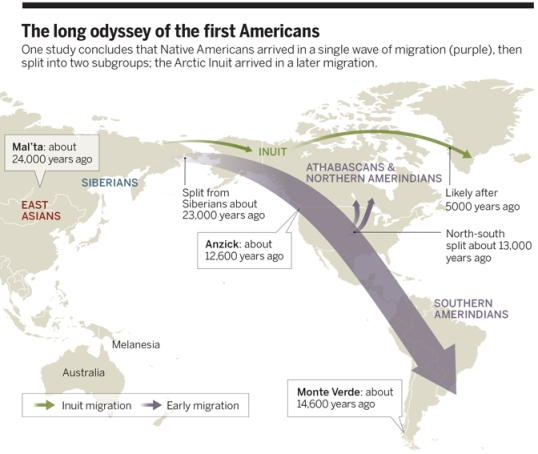
      A recent article concerning newly discovered DNA linking both the native tribes of North and South America with a common ancestral thread sparked my interest. Those new findings also triggered much discussion among the scientific and archeological communities whose conclusions have yet to be solidified. For many years, it has been widely accepted that these native Americans, both South and North of the equator, were spawned by Siberian peoples that traversed the Bering Strait during a time of relatively easy travel, some 23,000 years ago. To quote from the article (‘Mysterious link emerges between Native Americans and people half a globe away’ published online by the Sciencemag.org): (1)

      “They concluded that all Native Americans, ancient and modern, stem from a single source population in Siberia that split from other Asians around 23,000 years ago and moved into the now-drowned land of Beringia. After up to 8000 years in Beringia—a slightly shorter stop than some researchers have suggested (Science, 28 February 2014, p. 961)—they spread in a single wave into the Americas and then split into northern and southern branches about 13,000 years ago (see map, below).”

      Rather than involve ourselves in depth in an area of scientific and archologic complexity, I will attempt to sum up the article in a simplistic manner which may help us to derive the origins of the Iroquois tribes as well as that of their foes in North America. It seems the common DNA of modern tribes includes a connection to not only the Siberian peoples, but to those who populated the islands of Australia and Melanesia which are shown to be distantly contiguous to the Asian continent which housed the Siberian peoples. The argument now centers around not the known fact of their common ancestry, rather the dates and times of migration which would have led to insertion of this common genetic material. Did it occur prior to that initial migration over the Bering Strait? Or, did some Australo-Melanese group migrate by sea or land into the Americas and mingle their blood with that of the earlier arrivals? We will not worry about that issue here, but will include this fascinating commonality as part of this investigation into our possible Indian heritage. One thing seems for certain to this non-scientific personage, it had to have occurred early in their exploration and occupation of the Americas for it to be common to every Indian population of today who submitted their DNA for analysis.

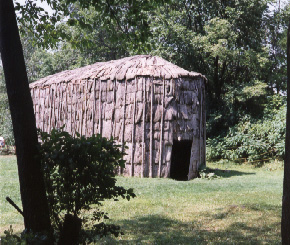
      Now to delve into the social and political structure of the Iroquois Indians. First of all, the name “Iroquois” was a name given the tribe by their enemies, the Algonquin, which was “Iroqua” (Irinakhoiw), meaning “rattlesnakes”. The French added their Gallic suffix “-ois” turning the insult into the name: Iroquois. The Iroquois actually called themselves the “people of the long house” or Haudenosaunee.
SEE: Longhouse photo taken by Maggie Sypniewski in London, Ontario, Canada. http://www.angelfire.com/mi4/polcrt/IroquoisIntro.html

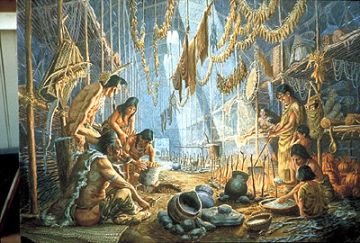
      The Iroquois were a matrilineal society. Land was held by the women, the longhouses built on that land were owned by the women and the men who fathered their children were invited in to that home to become part of her clan, but had responsibilities assigned to them by those women: primarily, hunting, fishing, building the longhouses, and providing the armed force to protect and preserve the existing community and to conquer enemy tribes in order to expand their territory and prestige. Some of these longhouses could become more than 200’ in length as the clan evolved and grew and could house up to 20 families.
(See Iroquoian Longhouse interior (artwork by Lewis Parker)

      The women of the clan were governed by a clan mother who had great power. She assigned duties and determined hierarchical prestige for both men and women of the clan. Each Iroquois tribe was comprised of three clans: wolf, bear and turtle, although their associated tribes, the Seneca and Huron had eight clans which included the additional hawk, deer, snipe, crane, and beaver. The work of the women was primarily to provide the sustenance for the clan. The three sisters, corn, bean and squash, provided the primary diet, augmented by the fish and game provided by the men. The women planted, nurtured and harvested the fields which were fertilized by the entrails and other remnants of the fish and game. The women also became expert in knowledge of the wild edible grasses, leaves, nuts, berries, barks and roots which could augment their diet or provide healing benefits. Because their agricultural diet was so limited, they exhausted the land over a number of years as well as the fish and game available to them which prompted a relocation of the tribe every 10-30 years.

      The clan mothers established a constitution and political structure that preceded any contact with European explorers. The complexity, logic, and success of their ruling method, therefore, was not influenced by their European contact but, in fact, contributed to the Europeans admiring and utilizing many aspects of that structure. The men of the tribe were chosen by the clan mothers to rule as sachems. Fifty men were awarded the title of sachem, known by some of the tribes as lords and by others as peace chiefs. These sachems ruled during times of peace, but during times of war, the power shifted to the war chiefs, who were also selected by the women. These war chiefs were selected on the basis of familial connection or birth, experience and ability but ruled only during times of war whereas the sachems generally served for life unless removed for misconduct or incompetence. In the council of sachems, a complicated method of assigned strength for voting was based on tribal prestige: “Onondaga 14; Cayuga 10; Oneida 9; Mohawk 9; and Seneca 8” (ibid, Sultzman). One could see the modern day electoral college and representation of states in today’s Congress and Senate mirroring that logic.
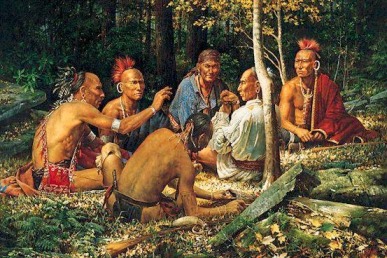
(See: Painting by Robert Griffing: “I Have Something to Say”)


      The Iroquois were, then, primarily farmers. But a more fierce warrior could not be found. They defeated enemy forces many times their number and size and, eventually, gained control of most of the Northeast of what would become the United States and the Eastern half of what is now Canada. The men of the tribe scraped off all body hair save and except for their signature scalplock, the Mohawk! They used shells from the oysters to perform their ritual exfoliation. The women of the tribe, however, wore their hair long and gained pride in the luxurious masses of dark, full hair.

      One of the darker sides of the Iroquois warlike habits included the ritualistic cannibalism of their defeated foes which has been shown by archeological means to have begun around 1400. I am sure this instilled fear and loathing among the Algonquin and Siouan, the Mahican and Lakota (Delaware) peoples as well.

      The Iroquois confederacy was made up, originally, of five associated tribes: the Cayuga, Mohawk, Oneida, Onondaga, and Seneca peoples. Later, a sixth tribe, the Tuscarora, was added and the Five Nations became known as the Six Nations. (See: Google Definition for Iroquois.) A direct quote from historian Lee Sultzman furnishes the greatest clarity as to the formation of the Iroquois League: (2)
The central authority of the Iroquois League was limited leaving each tribe free to pursue its own interests. By 1660, however, the Iroquois found it necessary to present a united front to Europeans, and the original freedom of its members had to be curtailed somewhat. In practice, the Mohawk and Oneida formed one faction in the council and the Seneca and Cayuga the other. The League's principal sachem (Tadodaho) was always an Onondaga, and as "keepers of the council fire" with 14 sachems (well out of proportion to their population), they represented compromise. This role was crucial since all decisions of the council had to be unanimous, one of the League's weaknesses. There was also a "pecking order" among members reflected by the eloquent ritual language of League debate. Mohawk, Onondaga, and Seneca were addressed as "elder brothers" or "uncles," while Oneida, Cayuga, and Tuscarora were "younger brothers" or "nephews."

      This hierarchical schism within an aligned tribal structure reflected the social structure which would set the Iroquois apart from other native American-Canadian tribes and which would provide both their greatest strength and ultimate weakness. Although they scrupulously pursued every remnant of the defeated tribe in an attempt to either win them over to association with their League by diplomacy or eradicated them, the tribes so absorbed were never granted equal status. The Iroquois believed themselves to be superior in intellect, power, and knowledge and treated absorbed peoples as secondary citizens thus creating segments of unrest and resentment.

      The story of the Iroquois would not be complete without reviewing what role they would play in the colonization of the land that would become the United States of America. When the French first explored the New World, they valued the furs which would bring wealth to them personally and prestige to the ruling class that supported their exploration. The story of the fur trade and the wars, diplomatic alliances, betrayals, and internal strife that it caused is historic. It is also much too complicated to relate in this article. The Iroquois were known not only for their fierce and powerful warriors, but for the sophistication and perfection of their diplomatic skills. Those many years negotiating among the various factions of the Five Nations tribes served their leaders well in their interaction with the French and later the British.

      Oh, yes. The British. For the ultimate diminishment of the Iroquois’ power and control would lie in their unfortunate alliance with the Redcoats during the American Revolution. After a series of betrayals by the French, who played the Algonquin and associated tribes against their perpetual foes, the Iroquois tribes, the decision was ultimately made to champion and assist the Brits in their war against the rebelling colony in the New World. This would lead to the ultimate defeat of the Brits and a distrust of the Iroquois that would not serve them well in the years following the establishment of the United States.

      Following the Revolutionary War, we would see the various factions of the Iroquois separated by failures of various attempted treaties, hostile internal strife, and distrust. Many of the tribe, beset by hostility on many sides and defeated by the outcome of their untimely and ill-ordained alignment with the British would lose trust in the League itself and in its leaders. Ultimately, segments of tribes would be relocated to reservations, relocate voluntarily to new frontiers and assimilate into other cultures.

      Today, the peoples inhabit reservations in Oklahoma, (Seneca-Cayuga), New York (Onondaga reservation), and in Wisconsin (the Oneida) but primarily in New York. Many returned to Canada where a large population of Mohawk reside on the St. Regis and Six Nations reserves in Ontario and in the Caughnawaga Reserve in Quebec. Many Cayuga are also located in the Six Nations Reserve. The Mohawk and Oneida who largely inhabit New York are fabled steelworkers, known for their daunting lack of fear for heights. A large gambling casino is also operated by them in Syracuse, New York. Most have been converted to the Christian faith, although a few remain followers of the ancient 18th century Seneca prophet Handsome Lake, who was strongly influenced by the Quakers. (3)

      What marvelous things we can discover from our armchairs! This is by no means a complete history of the Iroquois. I doubt any encyclopedia even could contain their history for it stretches back thousands and thousands of years into the depths of the Asian continent and, by the tiny bit of research revealed by the most modern of methods, DNA examination, proves some of the truths will remain mysterious and … hidden. For now, at least.
Bibliography:
    (1) http://news.sciencemag.org/archaeology/2015/07/mysterious-link-emerges-between-native-americans-and-people-half-globe-away:)
    (2) http://www.tolatsga.org/iro.html, Iroquois History, by Lee Sultzman.
          A marvelous website has existed online for many years and contains much of the work of historian Lee Sultzman. The website was created as a means of pooling knowledge of the history of native American Indian tribes and was the brainchild of Sultzman to provide a place where peers could absorb the material presented, furnish comments or corrections and thereby further a common history of each of the 240 tribes to be represented at that site. Although there now exists a comment by Jordan S. Dill who is listed as the person owning and maintaining the site: “All visitors here should also note that the author of the Histories, Lee Sultzman, has not communciated with me for years. Accordingly, I can only assume that the Histories you see at this site are the only Histories you will ever see at this site. Bottom line? Expect no more.” Website: http://www.dickshovel.com/up.html
    (3) http://www.infoplease.com/encyclopedia/society/iroquois-confederacy-the-iroquois-today.html

Researched and compiled by author.
Click on author's byline for bio and list of other works published by Pencil Stubs Online.

Cooking with Rod

Chicken-Poblano Tortilla Soup

(By Rod and Melinda Cohenour – New Year 2015/2016)

     This is a variation of the Southwest version of classic Chicken soup. It is said the original Chicken Tortilla Soup is a cure-all for anything that ails you. Natives even endow it with almost magical qualities. Some say it was originally created by the Shamans or Medicine Women. To taste it will make you a believer.

     My wife and I have created our own version of the classic Chicken Tortilla Soup and the following recipe is filled with our personal twists on the original. The recipe takes a bit of effort but is well worth it!


     Winter time seems to be the perfect season for warm soups and stews. This one is one of my favorites and allows my wife and I to not only prepare it together, but also Enjoy It Together!

Happy New Year and Bon Appetit!

To prepare chicken and broth:
  • 4-5 chicken breasts, bone in, skin on
  • 1 onion, quartered
  • 1 stalk celery, including leafy top, de-string and chop
  • 1 bell pepper, deseeded and cut in large dice
  • 2 cloves garlic – roughly chopped
  • 1 Tbsp poultry seasoning
  • 3 quarts water
    1. Place chicken and vegetables into large stewpot, season all with poultry seasoning. Add water and bring to a boil, lower heat and continue to simmer over low heat for about 45 minutes until chicken has cooked through and vegetables are soft.
    2. Remove from heat, permit to cool, remove chicken to cutting board and allow to cool.
    3. Remove vegetables from the liquid and set aside for later use.
    4. The liquid should be poured into a tall, narrow container and placed in the refrigerator to cool and permit fat to rise to the top. When broth has cooled and fat has solidified, remove the fat and set the container out to permit liquid to return to room temperature.
    5. Then, add the vegetables back to the broth and blend until smooth. Set aside. This process may require two to three steps depending on the size of your blender container. Your goal will be to have 2-3 quarts broth for soup preparation.
    6. Remove skin and bones from cooled chicken and cube. Set aside.
To prepare soup:
  • 2 lg Poblano peppers, char under broiler, when all sides are blistered with some brown and black spots, remove from pan, place in plastic bag and set aside while preparing the other vegetables. After other vegetables are chopped, remove the Poblano peppers from the bag and remove the outside skin. Flesh should be soft, so handle gently to cut into ½” to ¾” dice. Set aside.
  • 2 lg bell peppers, one red, one green, deseeded and medium dice (1/2” or so)
  • 1 lg onion, medium dice
  • 2 lg carrots, slice into ¼” dimes
  • 4 stalks celery, de-string and cut into ¼’ slices
  • 2 Tbsp vegetable oil
  • 1 tsp ground black pepper
  • 1 tsp cumin
Using large cookie sheet (or any flat oven-proof pan with a rim) spread diced vegetables over the pan, sprinkle with vegetable oil and lightly season with cumin and pepper. Gently toss by hand to make sure all surfaces of the vegetables are pretty evenly covered with oil, pepper and cumin. Place under broiler, about 6-8 inches from heat source. Broil until lightly browned, removing pan and tossing vegetables a couple of times over a 20-30 minute period. Remove from oven and set aside.

Additional ingredients and final preparation:
  • 2 packages Taco seasoning mix
  • 1 can drained whole kernel corn
  • 1 can drained black beans
  • Pkg Tortilla strips (lightly salted or No-Salt)
Optional garnishes:
  • Crisp, cold radish slices
  • Fresh cilantro leaves, no stems
  • Sour cream
  • Green onions, tops and bulbs, diced
  • Warm flour tortillas
  • Sweet creamery butter
  • Tortilla strips
    1. To large stewpot, add chicken, Poblano peppers and roasted vegetables. Add chicken broth and taco seasoning mix packets. Stir to ensure blended well. Add cans of drained corn and black beans.
    2. Heat soup over medium heat, do not bring back to a boil, but to a light simmer.
    3. When all has heated through, prepare individual bowls of soup:
To serve:

Place a handful of tortilla strips in a large soup bowl, ladle soup over the top. Sprinkle with grated cheese and a few leaves of fresh cilantro.

Serve with optional garnishes or select your own.

Click on author's byline for bio and list of other works published by Pencil Stubs Online.